Tencent (OTCPK:OTCPK:TCEHY) is well-known to have investments in many areas. Its WeChat platform has over 1 billion users and has 34% of China’s mobile data traffic. I detailed this in a previous article.
The company’s main revenue streams emanate from this platform. Gaming is the largest, representing about a third of revenue. Music, online advertising, Cloud connections, payments through Tenpay and increasingly fintech all feed off the Internet platform. As I detailed here, the music division has 800 million users based around the company’s Internet platforms.
Tencent has a new focus on business services on the Cloud. The company’s growing investments in the auto sector show a new strategic direction for Tencent. This is specifically in regard to EVs and what is termed the Internet of Vehicles. It is based around developments the company is making in AI. As with its other major revenue drivers, this will be based around its WeChat platform.
Tencent Strategy
The company has been quietly building up its presence in the auto sector. Its investments have been both in major auto manufacturers and in related auto service companies.
Tencent can have a strong strategic role to play as EVs replace ICE vehicles. This ties in with the company’s revised strategic plan earlier this year. At that time it declared it would focus more on business services on the Internet as opposed to consumer services. In this regard, it is coming up head-on with its rival Alibaba (NASDAQ:BABA), which has a lead in the area.
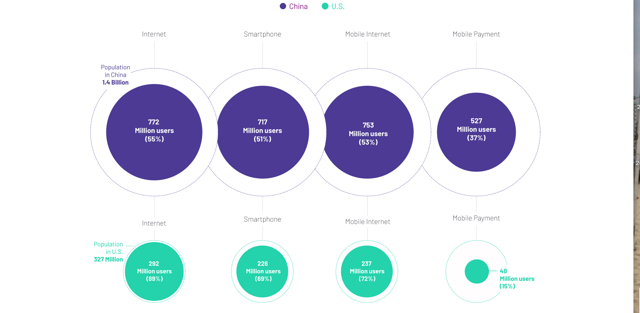
The magnitude of the Internet in China and how it dwarfs the USA is illustrated below:
(Source: South China Morning Post)
As I’ve written previously, Tencent is a complex company with many irons in the fire. Some think its investments have had somewhat of a scattergun approach. The new focus on business to business seems sensible though, given the government’s restrictions this year on gaming. Tencent is the world’s largest gaming company but may have become over-reliant on that sector for revenue.
The change in the company’s strategic plan ties in with encouragement from the government. Beijing has named Tencent as one of four companies to spearhead technology in the country, especially as it relates to AI. Self-driving cars and smart cities are part of the plan. Facial recognition is playing a large role in this. Tencent has its Computer Vision Research Centre focusing on facial recognition.
China is behind the USA in AI development. It is catching up, though. In particular, this relates to specific solutions within China. The government is also building up the country’s semiconductor industry specifically as it relates to chips for self-driving cars.
In September, Tencent launched its open platform for AI. This is accessed thorough subsidiary Tencent Cloud. The company’s cloud revenues are reported to have doubled in the last quarter. They are still small compared to Alibaba, in particular. Though, they are expected to see rapid growth in coming quarters.
The latest Q3 2018 results from Tencent indicate the company will continue to have plenty of resources to continue its investment strategy. In that period, revenues rose 24% to US$11.7 billion and profit increased 30% to US$3.4 billion. This was despite the slowdown in gaming in China.
The debt situation is very manageable:
Quick Ratio = 1.17
Current ratio = 1.18
Total debt-to-equity = 0.52
The Value to Tencent
The potential value of Tencent’s auto investments is difficult to gauge at present. However, a look at Google’s Waymo subsidiary gives some indication of the possible value added for Tencent. Morgan Stanley recently came out with a valuation for Waymo of US$175 billion. This is based on the value of its autonomous robotaxi business and logistics delivery business. There is additionally a small element for licensing value to other companies.
The Morgan Stanley valuation is higher than that of other analysts. It does, however, show the potentially huge business opportunities that companies like Google (NASDAQ:GOOGL) and Tencent are pursuing.
Specifically in China, the market for autonomous vehicles will increase much more rapidly than elsewhere in the world. Tencent has developed its own autonomous concept car and operating system. The company is looking at the value of monetising the journey customers take through its WeChat platform.
A report earlier this year by McKinsey emphasised the trend. It forecast autonomous vehicles in China would comprise 13% of all sales by 2030, and 66% by 2040. That would equate to 8 million autonomous cars by 2030 and 13 million by 2040. The sales values would amount to US$230 billion and US$360 billion respectively.
The value of chips used in such autonomous vehicles in China is expected to reach US$5 billion by 2021.
The long-term revenue potential for Tencent is obvious. It explains the company’s determined quest to invest in as many parts of the new world of EVs as possible.
EVs in China
China is the world’s largest auto market. In 2017, there were 24.72 million passenger and commercial vehicle sales in the country. There are 210 million private cars on the road. The trend of EVs replacing ICE vehicles is gaining pace in China. The official target from the government is that all vehicles on Chinese roads should be electrified by 2050. That day may seem a long way ahead. However, the pace of change to get there would need to be rapid with huge commercial revenues to be fought over annually.
The Chinese government classifies NEVs (new electric vehicles) as comprising three types. There are PHEVs (plug-in hybrids), BEVs (pure battery electronic) and a smaller category of fuel cell vehicles. Incentives vary across the types.
In the first eleven months of the year, PHEVs rose to 3.3% market share. This compares to 2.1% market share in 2017. Total EV sales this year are expected to exceed 1 million vehicles. This would represent about a 100% annual increase. The government has a target for the sale of 2 million EVs in 2020. By 2025, it wants annual EV sales to total 7 million. That would represent about 20% of total auto sales. Already, the China EV market is larger than the USA and Europe combined, and growing more rapidly.
The Economist Intelligence Unit (subscription required) had forecast EV sales worldwide would total 1.5 million in 2018. Over 60% of these sales will be in China. They predict sales of 2.2 million in 2019. That would be out of a total of new car sales worldwide of about 69 million.
The Ministry of Industry and Information Technology has stated that the market for “smart network vehicles” alone will be worth 100 billion yuan (US$15.9 billion) as early as 2020.
The drive from the authorities is not limited just to autos. E-buses are a huge growth market, led by Yutong and by BYD Auto (OTCPK:BYDDF). E-trucks are also growing rapidly.
The pace of the change from ICE to EVs can be argued. What cannot be disputed is that it is happening. This brings up the question of how EVs will change the way we travel. Car usage will trump car ownership. Freight delivery by autonomous vehicles will be a huge market. This is where Tencent stands to be in a strategically commanding position.
Tencent has been leading research in China into AI for the auto sector. The likely trend of calling up autonomous cars on one’s mobile would fit perfectly into the company’s WeChat platform. It would be an obvious extension of the widespread hailing of taxis on the WeChat platform. Payment by Tenpay would be seamless.
This drive from Tencent is not just China-based. The WeChat platform is expanding elsewhere in Asia as well. The move towards EVs in the rest of Asia is building up steam.
For instance, Singapore has a trial programme for users to call up buses on their mobile phones. Already as things stand, these could, in theory, be called up in Singapore on the WeChat platform and paid for by Tenpay. Alternatively, one could call up a taxi on Indonesian taxi firm Go-Jek, in which Tencent has a substantial investment. There are a lot of strands pulling together throughout Asia.
There is a very strong network of companies involved in the EV industry in China with whom Tencent now has investments or co-operation deals. I focus on some of these below.
Tencent and Tesla
TenCent has a 5% stake in Tesla (NASDAQ:TSLA) bought at a cost of US$1.8 billion. I detailed the possible ramifications of this in an article in 2017. Elon Musk then referred to Tencent as an “investor and adviser”.
Tesla’s China subsidiary has registered capital of 4.67 billion yuan (US$681 million). The factory in China is costing about US$2 billion to construct, according to Elon Musk. Some analysts have predicted it will cost US$5 billion in the long run. In the first instance, it is slated to produce 500,0000 vehicles per annum. Later investments, though, will include substantial battery manufacturing.
It is not known how exactly Tesla is financing this or whether Tencent will make a further investment in the company. Tesla’s finance requirements are currently closely tied up to Model 3 production. It would not be surprising to see a further investment from Tencent as the Shanghai factory comes up.
Autonomous vehicles will be a growing investment opportunity for Tesla. There is a potentially great fit with Tencent. Another opportunity for the two companies lies in online auto sales. Tesla famously has eschewed the dealer network model common to the auto industry. Tencent has investments in online auto sales.
Tencent and Didi Chuxing
Tencent has a stake in Didi Chuxing (DIDI), the company that took over the business of Uber (UBER) in China. The 2014 investment is thought to have been about US$100 million. Apple (AAPL) also has a substantial stake. In many ways, Apple seems to be pursuing a similar path towards autonomous vehicles as Tencent. It seems to be less far down the road compared to Tencent though.
Those on the WeChat platform can currently access Didi’s services. Didi is looking to set up EV car sharing services with 12 leading auto manufacturers in China.
Tencent’s tie-up with Didi Chuxing is expanding around Asia. One can view it as part of the struggle with Alibaba, which itself is teamed up with Uber.
Tencent and NIO
NIO (NYSE:NIO) had a high-profile IPO in the USA in September. Tencent’s stake represented 15.2% of the company and 21.5% of the voting rights. NIO’s chairman, William Li, has 17.2% of the voting rights. So, Tencent and Lio together have a strong hold on the company.
Other key partners of NIO comprise Mobileye (INTC), Baidu (NASDAQ:BIDU) and China’s largest battery manufacturer, CATL. This looks like a strong grouping to try to grab pole position in China’s high-end EV market.
NIO’s ES8 sports utility vehicle began deliveries in June. Its ES6 SUV should be debuting in the first half of 2019.
Tencent’s stake gives it further access to NIO’s upcoming stream of EVs and its special emphasis on autonomous driving. NIO is very much looking at the upmarket part of EV demand. It could be seen as a direct competitor to Tesla in the Chinese market. It will probably need a large re-financing package in 2019. It will be interesting to see what role Tencent plays in that.
Will Tencent be a major backer of both NIO and Tesla? That is a big question which may be answered quite soon.
Tencent and Here
HERE is a company concentrating on mapping data and location services. It grew out of the Nokia Maps business. With Tencent, it will be focusing on maps outside China. These can be channelled through the company’s WeChat and QQ platforms. This illustrates the international ambitions of Tencent as with its strategic investment in Indonesia’s ride-hailing company Go-Jek.
Apart from Tencent, other investors in HERE include BMW (OTCPK:BMWYY), Audi (OTCPK:AUDVF) and Daimler (OTCPK:DDAIF).
Tencent and FAW Group
In April this year, Tencent signed an agreement with the FAW Group. It is the old, state-controlled manufacturer of the “Red Flag” brand in China. The agreement was said to be to develop autonomous driving with a particular emphasis on Internet of Vehicles security solutions. They will develop auto-driving solutions together and work on actual auto models for mass production.
In October, the FAW Group received a startling US$145 billion credit line from the central government. This was said to be to “develop auto-driving solutions”.
The announcement of the April agreement was made by FAW Group on its Tencent site.
Tencent and Changan Auto
Also in April this year, Tencent signed an agreement with state-owned Chongqing Changan Auto Co. Tencent will have a 51% stake in the joint venture company, which will be developing an open platform to provide solutions for smart and connected autos. This seems to be a similar plan to the Apollo Project instituted by Baidu. That company already has an agreement with Changan. The agreement between Changan and Tencent has particular emphasis on developing an Internet of Vehicles platform. This will include data analysis of facial recognition and driver drowsiness detection.
Tencent and Guangzhou Automobile
In 2017, Tencent made its first major move into the EV market when it teamed up with GAC. At the time, the stated aim was to develop smart cars which would be connected on the Internet and aided by AI. The two companies are pushing the concept of “mobility as a service”, under the acronym “MaaS”. This uses Tencent’s operating system.
Tencent has developed the “iSpace” concept car using its “AI in Car” operating system. This is illustrated below:
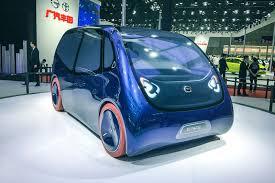
(Source: Autocar UK)
The AI in Car system can recognise users when they enter the vehicle and customise their journey experience. This then opens up the possibilities of further monetising the driving experience.
E-commerce for autos and speech solutions were also said to be areas of collaboration, as is insurance. Tencent’s main contribution in this regard will be by using its Cloud services and related technical support.
Tencent and Bitauto
Bitauto (BITA) is a company primarily involved in financing of the auto industry, in which Tencent has an investment. It is looking to be the largest online car finance platform. In another example of the interweaving between players in this industry in China, its chairman, William Li, is also chairman of NIO.
Tencent and Renrenche
Renrenche is a company selling used cars on peer-to-peer platforms. Tencent and Didi Chuxing are its top two institutional shareholders. Didi works very closely with Renrenche and plans to buy large numbers of used cars on the platform.
Tencent and Future Mobility Corp.
Future Mobility is specifically targeting the manufacture of luxury EVs. Its target was to have autonomous EVs on the road by 2020. That seems overambitious. In fact, all has been somewhat quiet about the progress this company is making. It is not certain how far the cooperation with Tencent has developed. It may well be that Tencent will focus more on NIO for the upmarket sector of the market.
Tencent and Harmony Futeng
Harmony also has a stake in Future Mobility Corp. Harmony itself wants to launch smart EVs on Tencent’s Internet platforms. In 2017, it invested US$195 million in a 300,000 capacity plant. As with Future Mobility, there has been a lack of firm news on development plans recently.
Tencent and Lyft
Tencent has a co-operation agreement with California-based Lyft (NASDAQ:LYFT). Lyft is mainly involved in ride-sharing developments. It has a lot of trials on the road in the USA.
Tencent has itself set up its own autonomous driving research team in California. The company has stated that this is focusing on various autonomous areas. These include perception and sensor fusion, motion planning and control, behaviour prediction, and machine learning.
California is, of course, the home base of Google. Its Waymo technology is generally considered to be the most advanced on the market.
Tencent and Tuhu
China-based car maintenance startup Tuhu recently raised US$450 million in a fund raising exercise. The company is involved in after-sales service and supply, including ordering online through a mobile app. That may be where Tencent’s strengths can contribute.
Conclusion
Gaming and fintech should be strong drivers for revenue growth for Tencent in 2019. These are at the centre of much of the company’s investments, as I detailed here. In Q3, the sector defined as “mobile payments and cloud services” grew 69%. Much of the future growth is likely to come from this.
Looking long term, the EV market based around the strengths of the company’s Internet presence could be a huge revenue earner. The Internet of Vehicles will be an important focus. WeChat will be the main platform, and the company’s AI developments the main driver. Tencent and its partners are looking to monetise the journey itself. It is a high-stakes game in which Tencent appears to have the will and the finance to last the course.
The promise of this looks like a good bet for those who understand the transformation of the Chinese auto industry from ICE vehicles to EVs.
Disclosure: I am/we are long TCEHY AAPL TSLA BYDDF. I wrote this article myself, and it expresses my own opinions. I am not receiving compensation for it (other than from Seeking Alpha). I have no business relationship with any company whose stock is mentioned in this article.
Be the first to comment