
Hive Blockchain Technologies (OTCPK:HVBTF) used to be known as Leeta Gold Corp., a Canadian gold mining company. During the crypto boom of 2017, they decided to jump ship and change their industry entirely. As a partner, they found Genesis Mining, headed by Marco Streng.
Source: Seeking Alpha

Genesis Mining?
Genesis Mining is the oldest living cloud mining provider for cryptocurrencies like Bitcoin (BTC-USD)(COIN)(OTCQX:GBTC), Ethereum (ETH-USD), and others. They operate facilities in Iceland, China and elsewhere in Europe (although they keep the exact location under tight raps).
You can see some of these facilities below:
Full disclosure here, I used to be a customer of Genesis Mining and this article should NOT be considered an endorsement of their services.
Cloud Mining?
Cloud mining is the process of mining for cryptocurrencies using someone else’s hardware and hosting for a fixed price under certain terms. For example, if you wanted to start mining Bitcoin, but you didn’t want to set up your own farm; one thing you might do is buy a cloud contract for a fixed amount of hash power if you believed the ROI would be positive.
Cloud contracts vary greatly due the particular cryptocurrency being mined, the type of contract, and especially the company selling said contracts. Genesis mining was the first big company in this space that wasn’t an outright scam; and they’re still operating to this day. However, many scams exist in cloud mining; ranging from facilities that simply don’t exist, to exit scams, to Ponzi schemes and more; buyer beware.
Hive Software
The hive software was originally created by Genesis Mining for use in their server farms. The idea was to create a simple way to manage a large number of machines in an easy-to-use interface for mining operations at scale.
You can see an explanation of this process here, taken before Hive was sold to HVBTF:
HVBTF Today
HVBTF is traded on the OTCPK markets, with a market cap around $113M USD. The share price has, predictably, been punished this year.
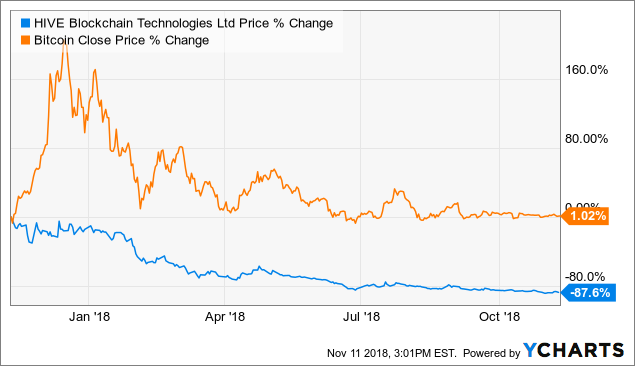
However, an increase in the number of shares outstanding from 47M to 310M has put additional downward pressure on the price. A majority of this increase comes from dealings with Genesis Mining and others in their acquisition process.
Hive is led by CEO Harry Pokrandt, who according to his LinkedIn profile has recently retired.
Balance Sheet
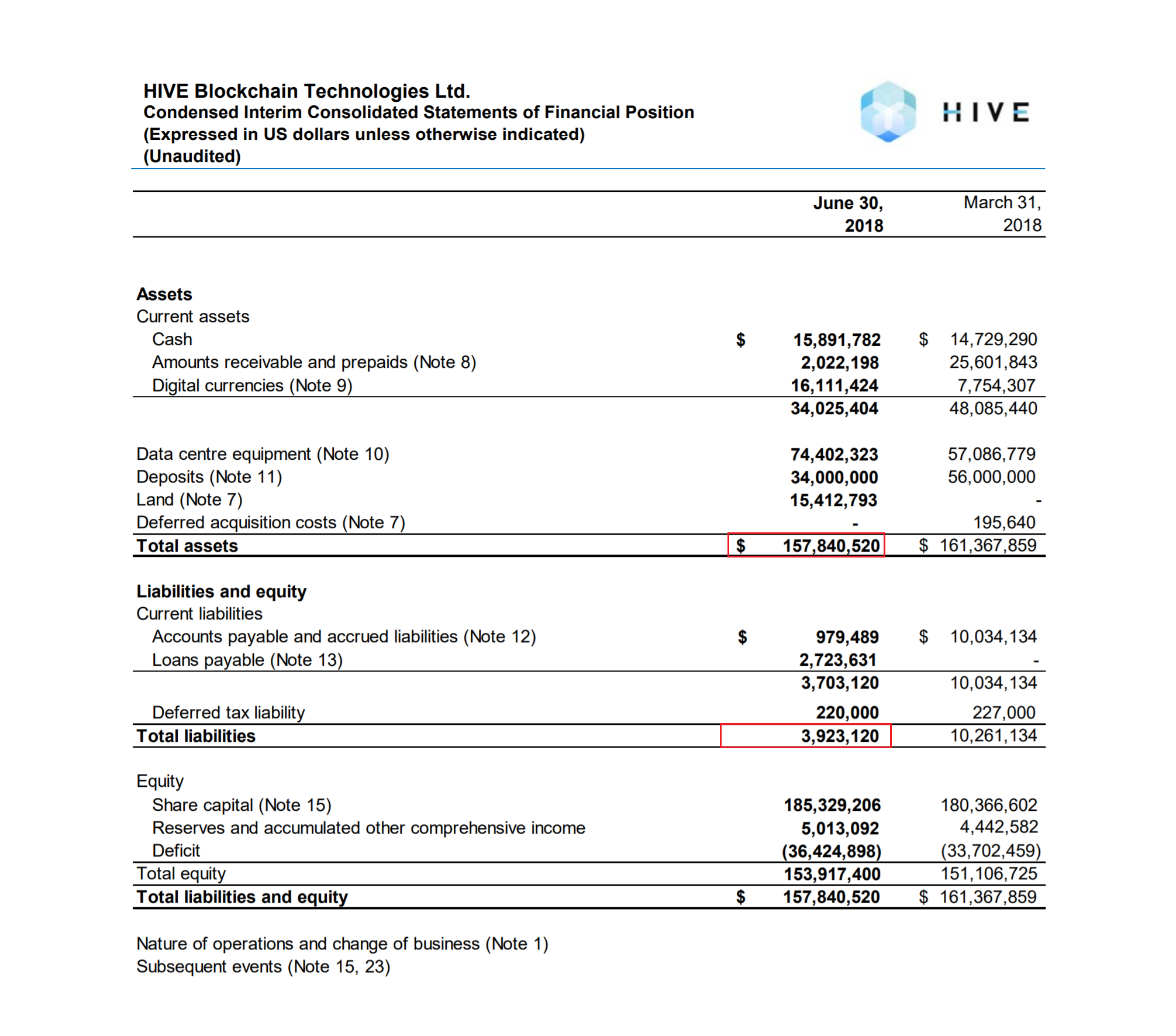
The balance sheet looks good, maybe too good.
 Source: Hive – 10Q Filing
Look at the ratio of assets to liabilities, it’s over 40/1. The company is also sitting on a pile of cash, which is handy given the state of the cryptocurrency market.
I’m a bit skeptical about the value of the data center equipment, due to the rapid depreciation of equipment right now. But, even if this is overstated, the losses they take on the depreciation will shield them from taxes when the market turns around. Additionally, the value of land alone dwarfs all liabilities should push come to shove.
Income statement
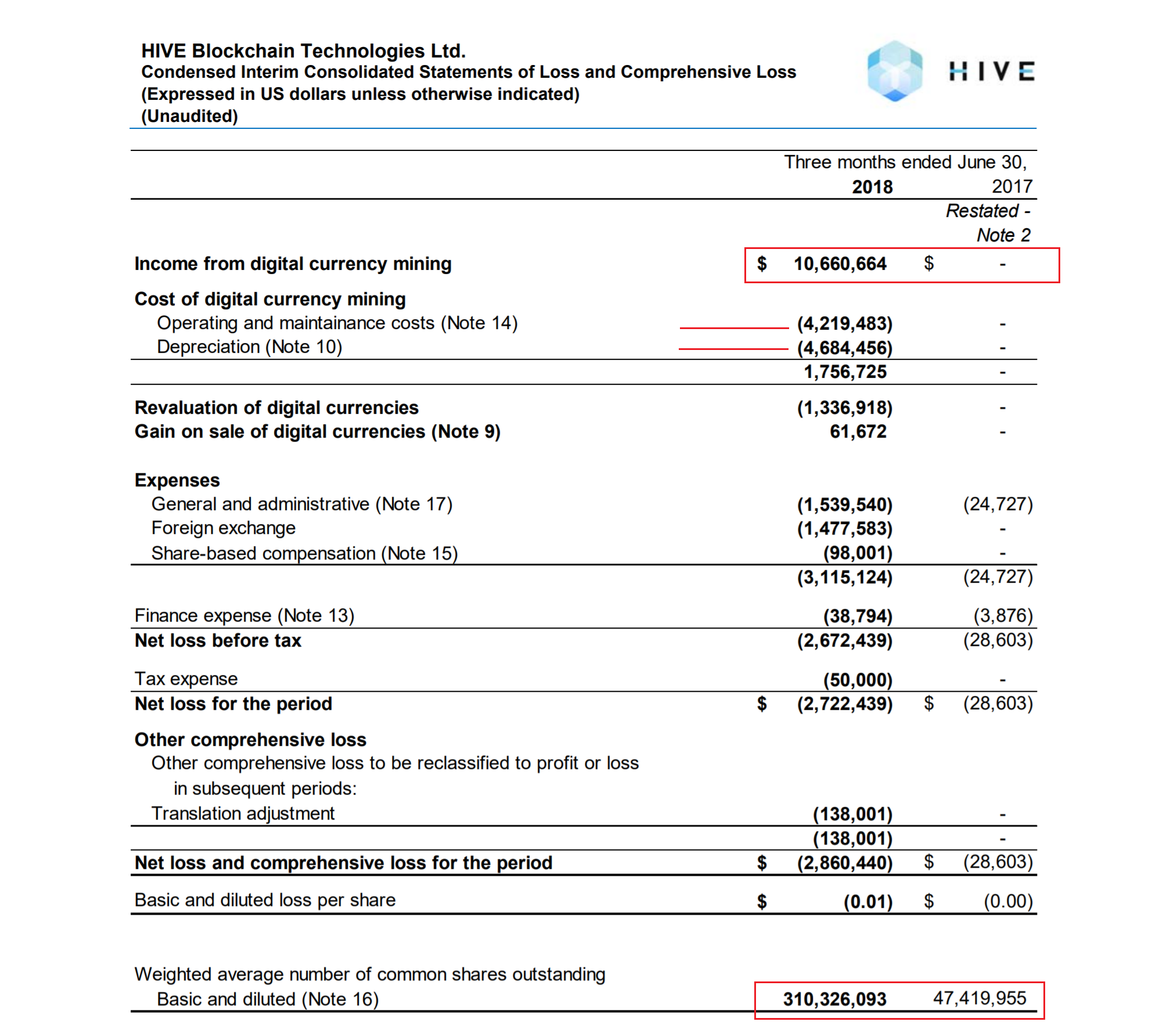
The income statement looks rather odd, since the company shifted operations from one sector into another recently. There’s not much we can compare it to, but let’s do our best anyway.
 Source: Hive 10Q, June 30th, 2018
With digital currency mining bringing in $10.6M and an operating cost of $4.2M, there’s clearly room for Hive to continue generating income during the protracted bear market. Recall that Hut 8 Mining (OTCQX:HUTMF) was able to produce similar results in their Q3 filings, and we know that Hut 8 Mining is a well-oiled machine. HUTMF called this the “mining margin,” and I like that term. For them, it’s the market price of a Bitcoin divided by the cost to mine that same Bitcoin (just the mining facility costs). For Hive, it’s more about Ethereum, but the concept is essentially the same.
The depreciation seems a bit low to me, but it might be in line with a 24 month depreciation schedule if we assume that the facilities and equipment are split about 50/50, where the building appreciates over 10 years or more and the mining rigs are on the more rapid schedule. Here’s my napkin math / best guess on how that breaks down.
- $74.4 Million / 2, half building and infrastructure, half mining rigs
- $37.2/24 months = $1.55 M depreciation per month
- $1.55 * 3 = $4.65 M depreciation for the quarter, which seems to be eerily close to the income statement
There’s a lot of new shares in town, as we briefly touched on earlier. This was because of the restructuring and acquisitions from Genesis Mining. The question this raises for me, is how many more common shares will the company issue? Investing while the market is down is generally wise, but how much more do they have planned?
Concerns
I have a number of concerns here with Hive, in particular with their partner Genesis Mining. First of all, Genesis Mining has developed quite a bad reputation with the community for a number of reasons.
Immature behavior
While I’m sure that some of the crypto-kids were just googly-eyed over some of this company’s antics; serious investors are less likely to be awed. For example, Genesis Mining paid for these billboards placed in Omaha.
In addition to this, they staged mock protests at the Consensus Blockchain Conference.
This all smells of a company with more money than sense, but where did all the money come from?
Poor relationship with customers
Some of these returns came from being in the Bitcoin mining business from the early days, but some of it came at the expense of Genesis Mining’s own customers. You see, many people who were new to cryptocurrency purchased Genesis Mining’s popular “lifetime contracts” near the peak of the Bitcoin bubble. It turns out these contracts had a termination clause that ended their operation if market conditions remained poor for an extended period of time.
The details were all included in the fine print, so I’m not saying that Genesis Mining broke any laws here; simply that their marketing was very misleading. Some unfortunate clients purchased large “lifetime mining contracts” in January of 2018, which were scheduled to launch in March of 2018. Much to their surprise, these contracts were terminated in June of 2018, resulting in massive losses.
A popular YouTuber, Voskcoin did this review of Genesis Mining.
Bottom line, Genesis Mining is not a scam, it’s just a terrible investment for customers that happens to have terrible customer service. Not exactly a company I would want to work for or invest in, or have as my parent company or partial owner (cough, Hive, cough).
Ethereum and Proof of Stake
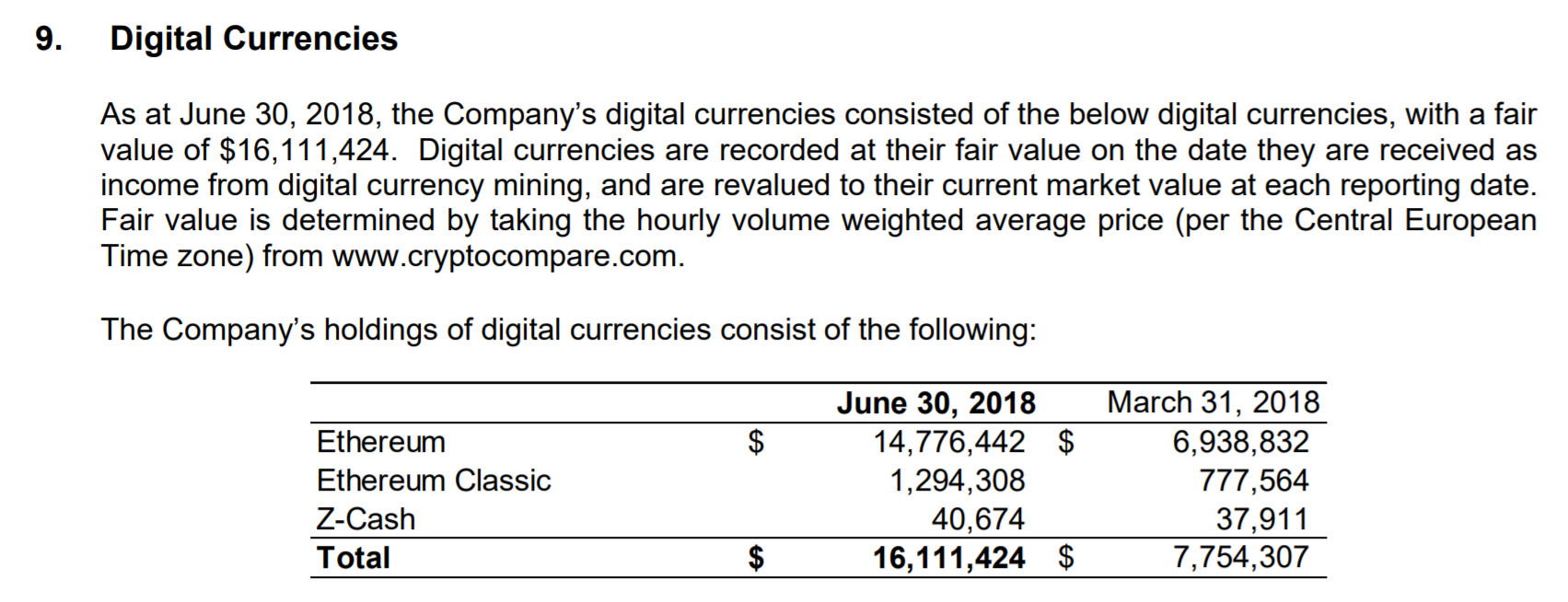
If we look at the digital token holdings of Hive, we see that they consist mostly of Ethereum.
 Source: Hive 10Q, June 30th, 2018
So, what’s the problem you may ask? Well, Ethereum is the cornerstone of the GPU mining world today, and they are phasing out mining.
Some of you are heading to the comment section now to say that Ethereum has been “switching to PoS” since launch and it may still take years. But, the latest news we have is that the difficulty bomb is on the way; and the next big network upgrade moving Ethereum closer to eliminating mining completely is due out in January of 2019.
Also during the call, developer Lane Rettig shared research regarding ethereum’s so-called “difficulty bomb.” The difficulty bomb is an algorithm embedded within ethereum’s code that makes blocks steadily harder to mine, and was put in place to act as an incentive for encouraging regular updates to the network.
According to Rettig, the difficulty bomb will be noticeable from January, leading to 30-second block times by April or May of next year. – Coindesk
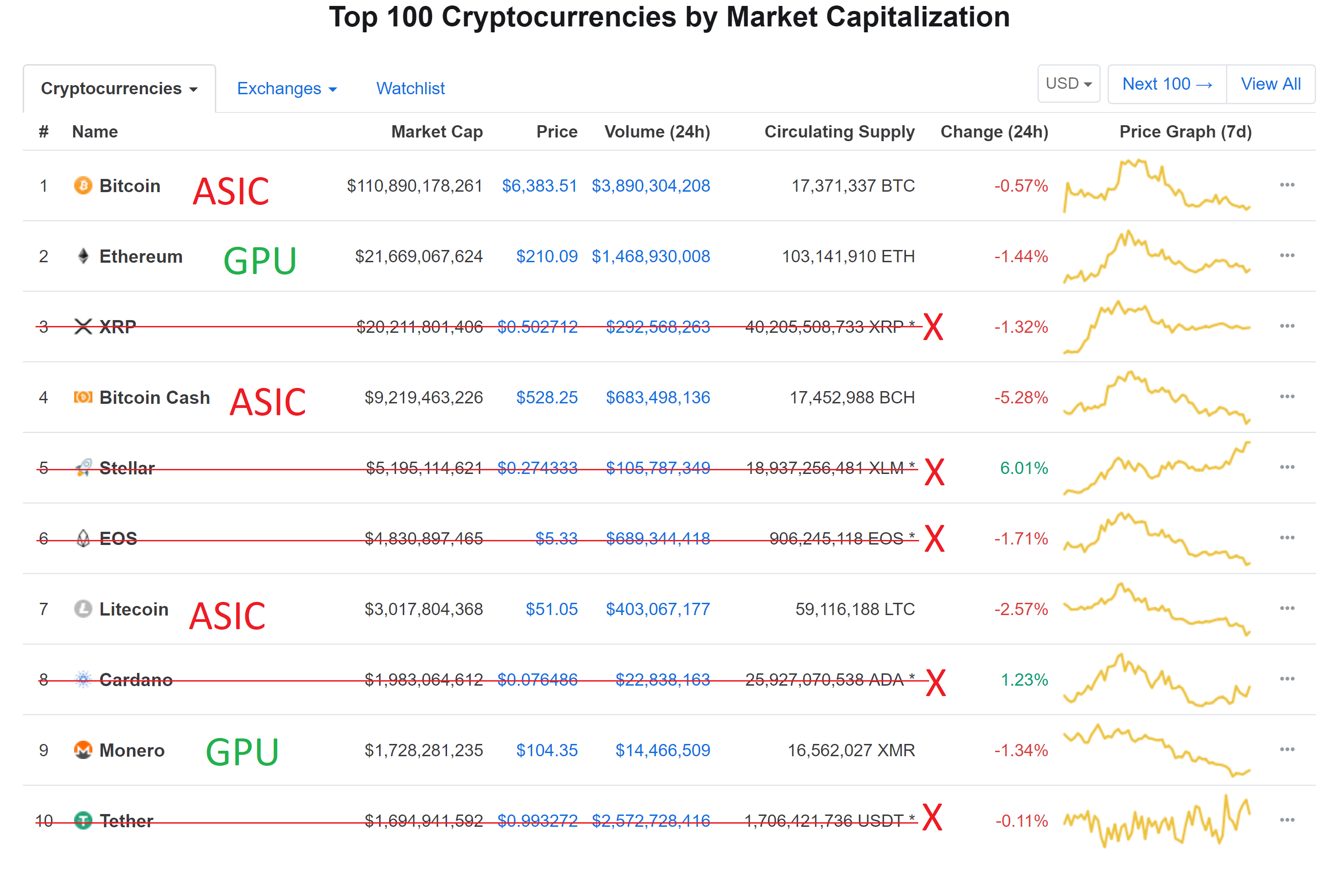
It’s entirely possible that other cryptocurrencies absorb the excess mining power, but let’s look at the state of the GPU mining world right now. Among the top ten cryptocurrencies, how many do you think can be mined with a GPU? How many can be mined at all?
 Source: Coinmarketcap.com
It turns out that five are not mineable, three require ASICs and only two of the remaining coins can be mined with GPUs. Look at the market cap of Ethereum versus Monero (XMR-USD). The number of miners a coin can support is directly proportional to its market cap (with some variance for the algorithms which don’t run exactly the same on every GPU, some have advantages in certain algos).
Ethereum is currently supporting 12.5x more miners than the number two GPU minaeable coin, Monero, using this simple yardstick. So, when Ethereum exits the mining game, where are all those GPUs going to go?
I hope I’m explaining this clearly. Basically, each cryptocurrency that can be mined with a GPU already has the proper number of miners to balance out difficulty and profit (it’s a free market). If the number one GPU mineable crypto leaves the stage, what are all those machines going to do? They certainly can’t be absorbed by Monero alone, since Monero already has the correct amount of hash power and only needs 1/12th that of the Ethereum network to be at equilibrium.
Sure, there are myriad of new use cases that have been proposed, but none of them can compare to the profits from crypto mining, which created the market in the first place.
For me, this is a concern for a company engaged primarily in mining Ethereum. That difficulty bomb will arrive one day soon, and if it comes in the dead of night (during a deep bear market) it’s going to wreak massive havoc.
Conclusion
While I’m not a huge fan of Genesis Mining, Hive might be a good bet under certain market conditions. Genesis Mining certainly has mining expertise, they are an industry leader after all. But, I’m concerned about their poor business practices and the exposure to Ethereum. Depending on how it all plays out, this could be a massive “big bath” for investors.
However, if the market turns around soon, then it’s possible that new mineable cryptocurrencies appear (or suddenly become popular enough to support more GPU miners). Also, promises of AI on the blockchain could create demand for all the GPUs being used in mining. Other use cases include modeling fluid dynamics and rendering CGI, but these ideas have yet to mature.
I’d recommend approaching HVBTF with caution in the meantime.
This article was published first in Crypto Blue Chips.
Disclosure: I am/we are long BTC-USD, ETH-USD, HUTMF.
I wrote this article myself, and it expresses my own opinions. I am not receiving compensation for it (other than from Seeking Alpha). I have no business relationship with any company whose stock is mentioned in this article.
Editor’s Note: This article covers one or more microcap stocks. Please be aware of the risks associated with these stocks.
Be the first to comment