
OPEC is the international oil cartel that has been around since 1960. The organization began in Baghdad, Iraq and the founding members were Iran, Iraq, Kuwait, Saudi Arabia, and Venezuela. The Middle East is home to more than half the world’s reserves of crude oil, but the South American nation of Venezuela potentially holds the world’s largest single-country reserves of the energy commodity. Throughout the years, OPEC had been a dominant force in the international oil market with the ability to influence prices dramatically at times.
In a recent article for Seeking Alpha, Robert Boslego made readers aware of current legislation approved by the US House of Representatives Judiciary committee called the NOPEC legislation that would make OPEC illegal and strip members of sovereign immunity protections making them liable to antitrust lawsuits, but more about that later.
In Yiddish, a schmo is an idiot. Growing up in Brooklyn, N.Y., another unflattering derivation of the term schmo was the schmohawk, which I guess was one or two steps below an ordinary schmo in social ranking and intelligence. Mr. Boslego’s piece made me think a lot about OPEC over the past weekend, and I have decided to stop calling them by their common name and replace it with SchmOPEC because that is what the once-powerful cartel has become, a collection of oil-producing schmos with no power and no clue. The original leaders of the cartel would spin in their graves at the many mistakes made by their successors over recent years. Schmopec could be one step below the schmohawk on the scale of innate intelligence.
The S&P 500 Energy Sector SPDR (XLE) is an ETF that holds many of the world’s leading oil and oil-related companies. Since the December low in crude oil and the stock market, the XLE has been making strides on the upside, and that looks set to continue.
An interesting piece from Mr. Boslego over last weekend on NOPEC
In his article, Robert Boslego provided readers with news OPEC was “proclaiming innocence” stating that it is not a cartel nor is involved in any way with fixing oil prices. Mr. Boslego opined that President Trump would be pleased to sign legislation that cut the legs out from under OPEC and that the Saudis would exit OPEC in the wake of his signature. Without the Saudis, OPEC would “dissolve” according to the piece. When it comes to KSA, the leading OPEC producer, the nation announced that they were “studying” a world without OPEC in 2018.
I do not disagree with Robert’s assertions in the piece. A cartel is a clear violation of the Sherman Ant-Trust Act of 1890.
The piece generated lots of comments which added to its value to readers. When it comes to OPEC, the cartel has become almost supportive of the energy business in the US over recent years.
OPEC may violate US and International price fixing laws, but they served a purpose for the US
The oil crisis in the 1970s led to the growth of the oil business in the United States to achieve independence from reliance on Middle Eastern petroleum. Over recent years, technological advances in fracking and discoveries of economic reserves of oil in the shale regions of the US caused production to rise. The 2016 Presidential election in the US ushered in a golden age for energy output as President Trump slashed regulations and provided tax reforms that together with technology caused production costs to decline making output economic at much lower price levels than in the past.
Faced with an emerging world power in oil production, OPEC panicked when the price of the energy commodity declined from over $100 per barrel in 2014 to under $30 2016. Their initial plan to increase output to wash the US out of the oil market by forcing the price below production costs failed, miserably. At the same time, it opened the door for the Putin government to expand their already significant presence in the Middle East. In 2016, Russia and Saudi Arabia led the world in oil production. Within OPEC the tension between Saudi Arabia and Iran rose to a level where without mediation the two sides could not agree on anything let alone oil production policy.
The Russians had been cementing their ties with Iran over their joint involvement in Syria in support of the Assad government. In February 2016, when the price of oil was languishing on the lows and members of the cartel were feeling the pain of lower revenues, the Russians helped put together a production cut that saved the day for the members. Russia under their oil minister Alexander Novak who takes his marching orders from President Putin emerged as the leading force in the cartel, even though they have never been a member. At the most recent meeting, the oil ministers could not agree on the level of an output cut until Russia intervened to mediate a 1.2 million barrel per day decline. In another sign of discord at the meeting, the UAE resigned from the cartel as they have faced a blockade by KSA.
Meanwhile, OPEC production cuts came at a time when US output soared. Today, the US is the world’s leading oil producing nation with almost 12 million barrels of shale flowing from wells each day. Therefore, OPEC production cuts that have supported the price have been highly profitable for US producers. While NOPEC legislation would rid the world of its most historically powerful cartel, global oil policy these days does not occur in Vienna at biannual OPEC meetings. And, the OPEC policy of trimming output over recent years has created a bonus for the US where production continues to grow.
Saudi Arabia is a toothless tiger in the oil world; MBS is Putin and Trump’s water boy
Saudi Arabia was the most powerful oil-producing nation in the world for decades. In the 1970s, the Kingdom engineered the oil embargo on the United States after American support for Israel during the Arab-Israeli War.
The Middle East has always been a complicated and volatile part of the world, but they held onto influence by supplying the world with petroleum and controlling the price of the energy commodity in the 1960s, 1970s, 1980s, 1990s, and even at the beginning of this century. The Saudi oil minister was always one of the world’s most powerful men, but that changed dramatically.
The Saudis lost control of the cartel when US production began to rise, and in 2016 when the price tanked, they ceded their position to Russia. At the same time, a new King in KSA with a young son who is now the Crown Prince decided to move the Saudi economy away from dependence on oil which further transferred power to the Russians. A proxy war in Yemen between KSA and the theocracy in Teheran further cemented Russia’s role as mediator, mentor, and power-broker in the region. The rise of US production shifted global oil policy from OPEC headquarters in Vienna to the Kremlin in Moscow and Oval Office in the United States.
Perhaps the final straw for Saudi influence came in October 2018 when Saudi security forces murdered Washington Post journalist and Saudi national Jamal Khashoggi at the Saudi embassy in Turkey. Following that event, the Saudis capitulated to President Trump’s demand to pump up their volume of production as new sanctions on Iran were set to take effect last November. At that point, the King of Saudi Arabia and Crown Prince MBS became pawns of Russian and US influence, likely to avoid the unpleasant consequences of their alleged involvement in the murder of a critic of their government.
Russian collusion – it’s not about the 2016 election, it’s about oil
The news in the US is filled with stories about Russian influence in the 2016 Presidential campaign. At the same time, the opposition party and special prosecutor have been working tirelessly to uncover collusion between the Trump campaign and the Russians during the election. However, the actual collusion between Russian and US interests have occurred naturally as a result of events in the international oil market over recent years. The rise of US output in an environment of falling production costs that resulted from technological advances and regulatory reforms and Russia’s position as the not so invisible hand leading OPEC policy have caused production policy to now reside in Washington and Moscow. While Saudi Arabia remains one of the leading three producers, Crown Prince MBS is beholden to the US for military protection and to Russia for keeping a leash on Iran.
The US and Russia control oil – schmOPEC is now a trade association with others pulling the strings
When the oil ministers of OPEC meet later this year for their biannual gathering to decide if they will continue with the current level of production cuts, the decisions will come from policies of the US and Russian governments. The Saudis will be looking over their shoulder to play both sides of the fence by placating both President Trump and President Putin.
The rest of the ministers will sit in the meeting pontificating their positions, but they have been reduced to nothing but a collection of schmos with absolutely no power when it comes to controlling the price of oil or making policies that can alter the current course of history.
US legislation has bipartisan support to put OPEC to sleep, and President Trump will gleefully sign the bill into law. However, the reality is that OPEC became NOPEC when the Russians burst on the scene to respond to rising US output. The US put the cartel to sleep as it became the world’s leading producer of the energy commodity and any legislation will be a ceremonious occasion and political tool. Technology and regulatory reforms that put the US in a dominant position in the oil market are responsible for the demise of what is now schmOPEC. Any legislation is a mirage that will make nervous ministers like the current Secretary-General continue to proclaim that they are nothing more than a trade association. The fact is, since 2016, the schmos have lost their grip on the oil market. Left to their own devices, OPEC became NOPEC and is now schmOPEC because the schmohawks handed their power to Russia and the US. With Saudi Arabia at odds with Iran and the UAE, the previous cohesion of the cartel came apart at the seams.
Meanwhile, the price of oil has been rising since the late December low making the cartel feel good about their most recent output cut. And, a trade deal between the US and China will likely ignite the global economy and cause demand for the energy commodity to rise leading to even higher prices.
The S&P 500 Energy Sector SPDR holdings include:
Source: Yahoo Finance
The recovery in oil and stocks since December has caused the ETF to move to move higher. 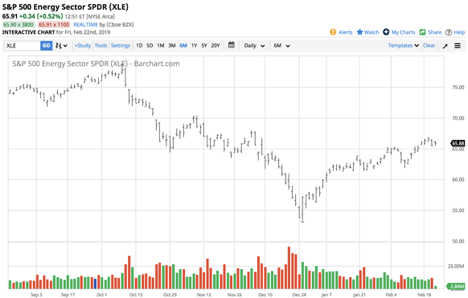
Source: Barchart
After reaching a low at $53.36 on December 26, the XLE rose to $65.91 on February 22, a rise of over 23.5%. A trade deal with China and a continuation of the rally in the stock market are likely to take the ETF higher over the coming weeks and months as the price of oil looks set to continue its recovery.
The big winners are the US government and oil companies and Russia who will allow the schmos to go along for the ride so long as they continue to march to the beat of the drummers in Washington and Moscow who now are in firm control of the global oil market.
The Hecht Commodity Report is one of the most comprehensive commodities reports available today from the #2 ranked author in both commodities and precious metals. My weekly report covers the market movements of 20 different commodities and provides bullish, bearish and neutral calls; directional trading recommendations, and actionable ideas for traders. I just reworked the report to make it very actionable!
Disclosure: I/we have no positions in any stocks mentioned, and no plans to initiate any positions within the next 72 hours. I wrote this article myself, and it expresses my own opinions. I am not receiving compensation for it (other than from Seeking Alpha). I have no business relationship with any company whose stock is mentioned in this article.
Additional disclosure: The author always has positions in commodities markets in futures, options, ETF/ETN products, and commodity equities. These long and short positions tend to change on an intraday basis.
Be the first to comment