
What’s your idea of a perfect investment?
That’s a tricky question, but those looking for above average current returns, along with reasonably good price appreciation prospects over time – and with only modest risk – will certainly want to consider apartment communities, office and industrial buildings, shopping centers, and other similar real estate investments. While some time ago, these highly profitable investments may have been reserved to high net worth individuals and institutions, it is today easier than ever before to invest in real estate through high yielding real estate securities or REITs.
About 90% of millionaires credit real estate as a major contributor to their net worth. Yet, most people never invest in real estate due to simple lack of knowledge or education.
As a former private equity real estate investor who later turned to REIT investing; I offer a breakdown of my “Top 10 Reasons” why I put a major portion of my net worth into real estate; and even more importantly: How I do it.
Beautiful Downtown San Diego and its property investments ranging from single family houses to skyscrapers:
#1 – Remarkable Durability and Stability in Value
Real estate is the epitome of Benjamin Graham’s definition of an investment. It’s quite simply a piece of planet earth that combines land with a man-made structural improvement. As a result, it’s a tangible asset that provides clear value to its occupier. Additionally, the nature of its value is limited, necessary, and flexible – giving it remarkable durability and stability in value.
Real estate is limited because the amount of land on planet earth is finite and only certain portions of earth are suitable for various types of real estate (i.e., the Sahara Desert is not ideal for most types of farming).
Real estate also is necessary because everyone in the world needs shelter in which to live, farmland for growing food, factories to produce goods, storehouses to keep surplus food and goods until needed, etc. Simply put: Real estate is absolutely needed for the survival and prosperity of the human race and cannot be replaced.
Finally, real estate is flexible in that many buildings can serve multiple purposes with only a little or even no changes needed to the land or the structure and even when significant redevelopment is needed, it can still often be done in a profitable manner over the long run. As a result, even property that’s currently allocated to a business enterprise that is no longer sufficiently profitable still possesses significant value due to its flexibility.
These qualities make it extremely unlikely to become worthless over time unless it’s grossly mismanaged and overleveraged. This is especially true in the case of REITs because they own highly diversified portfolios of 100s of properties that are professionally managed and use only moderate leverage.
#2 – Predictable Long Term Appreciation
As long as the property is in a good location and leased to a solid tenant, not much can go wrong in the long run. Of course, there will be cycles, but the long-term trajectory will remain the same: way up.
In 1955, we were 2.7 billion people on Earth. Today, we are 7.7 billion, and by 2050, we are expected to be close to 10 billion. All these people will need a place to live, shop and work. At the same time, there is a strong trend toward urbanization, and desirable infill locations are therefore becoming in ever increasing demand. This will, in the long run, be reflected in higher rents and higher valuations for quality REITs.
#3 – Defensive and High Income
Since real estate is a vital necessity to people and businesses, the cyclicality of the demand for properties is greatly reduced, regardless of economic conditions.
In a recession, tenants may receive a rent cut to keep occupancies at high levels, but overall, the income tends to remain relatively resilient and consistent over the full cycle. During the worst real estate market crash of man-kind (great financial crisis), the NOI of REITs only saw a slight temporary decline, and quickly recovered much higher in the coming years:
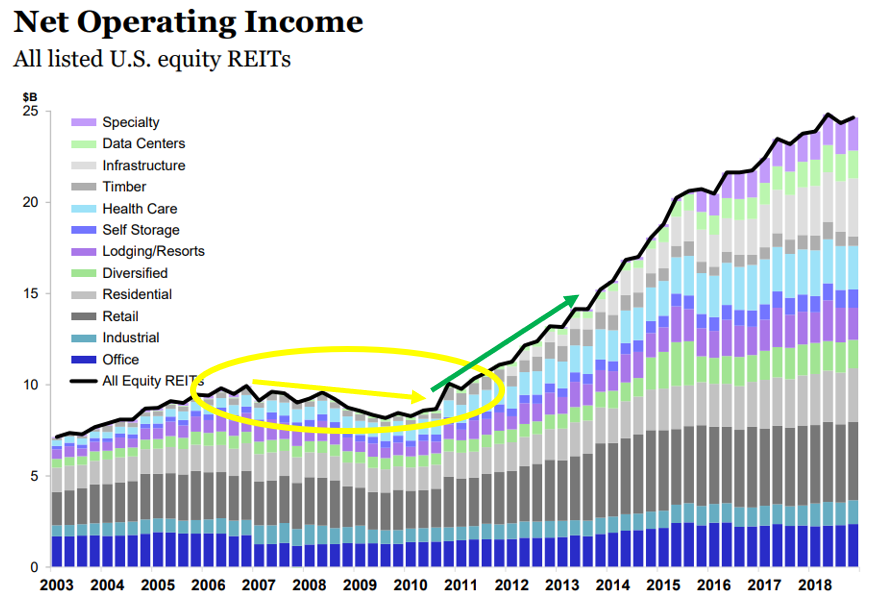
Cap rates have come down, but still today, high-quality properties can be purchased at 6-7% cap rates which along with some cheap leverage, can provide close to a 10% cash-on-cash return to investors. With REITs trading at a discount to NAV, this math is put on steroids.
#4 – Cheap Debt to Compound Wealth
What really puts real estate and REIT investors ahead is their capacity to leverage their property investments. It is simple to get a long-dated fixed rate mortgage with a low interest rate to finance the majority of a property investment. Rental investors will often use this trick to maximize returns and use up to 4-to-1 leverage. I have often shared that this may lead to excessive risk taking; but even with a more reasonable 2-to-1 leverage, rental investors can boost returns significantly:
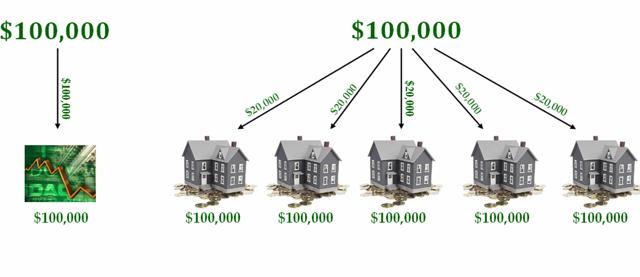
Using back-of-the-napkin math, if you can finance your property at 2-to-1 leverage, pay a 3-4% mortgage rate, and buy a ~6% yielding property with prospects for 2% annual appreciation, you are set for annual returns that far outperform most stocks and bonds. With REITs you enjoy the same benefits of leverage, but without having to sign in on any loans and give personal liability.
#5 – Bond-Like Cash Flow Thanks to Lease Agreements
Real estate investors lease their properties to tenants who are required to sign a lease agreement to mitigate investment risks.
The fundamental difference between a bond and a lease is surprisingly small. In both cases, there is an agreement between two parties to lend something in return of a cash payment. In the case of bonds, the lender lends money and receives interest payments in return. In the case of a lease, the real estate investor “lends” the property and receives rent payments in return. The terminology is different, but the general concept is identical. There is a contractual agreement that obligates the borrower/tenant to pay interest/rent to the investor.
Since most leases range over many years, investors can sit back and earn bond-like cash flow with minimal volatility.
#6 – Inflation Hedge
Real estate provides natural protection against inflation because it is a vital and tangible asset to our society. With the printing presses around the world totally out of control, real estate help me sleep well at night – knowing that it will always be valuable – regardless of how our underlying currencies perform.
In fact, most leases are today directly tied to an inflation index and rents increases can be automatically enforced. Research from NAREIT demonstrates that the dividend growth of REITs has outpaced inflation in all but two of the last twenty years.
#7 – Stock Prices are High and Interest Rates are Low
The stock market is still hovering near all-time highs and considered by many metrics to be significantly overvalued. At the same time, it’s facing immense uncertainty and increased volatility due to geopolitical and macroeconomic factors, leaving it teetering on the edge of a bear market.
Meanwhile interest rates remain near historic lows, making investments in bonds nearly as risky and unattractive as stocks. With the odds seemingly stacked so heavily against income investors looking for a safe place to allocate their life savings, real estate (and REITs) become particularly appealing.
#8 – Tax advantages
Real estate investors enjoys valuable tax benefits through the deduction of all property-level expenses, plus depreciation and interest expenses. Especially the deduction of depreciation can prove to be valuable since it’s a non-cash expense and properties tend to appreciate over time.
Similarly, REIT vehicles are tax-advantaged in that they do not pay any corporate tax and investors can hold the shares in a tax-deferred account.
#9 – Retirement Income
For those investors who look at real estate investing as a very long term proposition, the potential to retire on rental income is very real. I personally know many investors who started small and built vast portfolios of properties that allowed them to retire early.
Moreover, I have also come to know many investors who achieved the same results and managed to retire early with the help of a diversified and high yielding portfolio of REIT investments.
Real estate and REITs in particular are ideal for retirees as they pay high and consistent income that requires minimal efforts from the investor.
#10 – Greater Total Returns in the Long Run
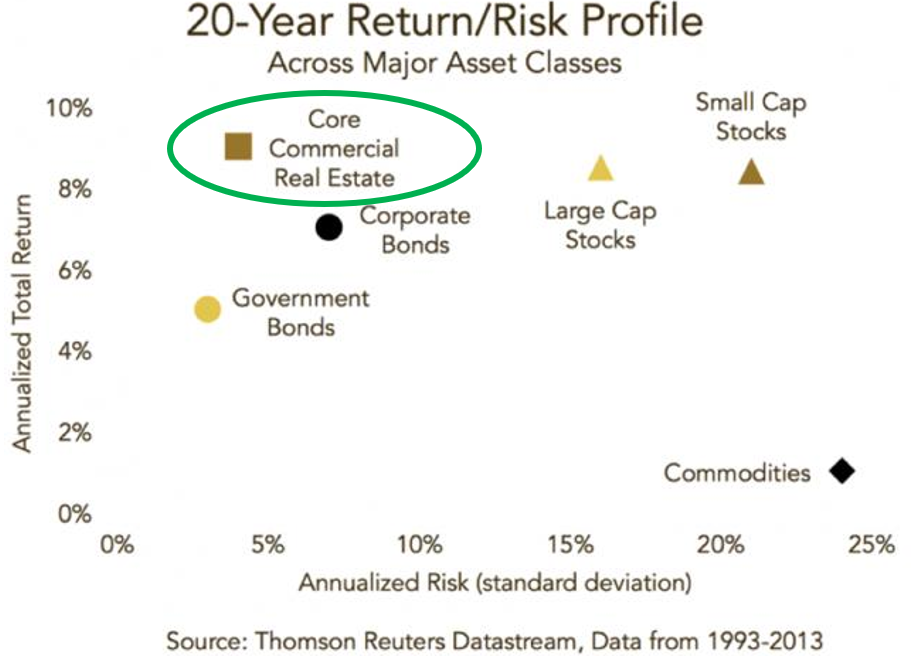
Real estate has a phenomenal long-term track record of generating the best risk-adjusted returns of all asset classes, making the decision to buy today and hold for the long haul even easier to make.
Publicly traded real estate securities, or REITs, have done even better and outperformed private real estate investments. REITs have historically produced up to 4x higher total returns than the S&P 500 from 1997 until 2016:
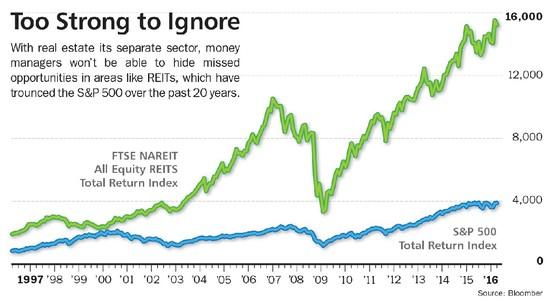
Given that REITs are today priced at a slight discount to their historical average; balance sheets are stronger than ever before; and the underlying nature of real estate investments remains overwhelmingly attractive; we would not expect the future results to be much different.
The Best Approach to investing in Real Estate in 2019
Because of these 10 reasons, most investors understand that they should invest in real estate whether it’s for:
- High current income.
- Long-term appreciation.
- Inflation protection.
- Diversification.
The more difficult part is to determine HOW to invest in real estate? When looking at all the different possibilities, most investors consider two main options:
Option 1: Invest in private real estate (or a private real estate fund)
Option 2: Invest in publicly traded REITs
REITs vs. Private Real estate
The first thing that comes to our mind when discussing direct real estate investments is the big ugly “Triple Ts”: Toilets, tenants, and trash.
As we pointed out in a recent article on rental investing, when you invest in rentals it’s anything but a passive investment. First, you have to conduct extensive due diligence to ensure you are purchasing a good property in a good location at a good price. Next, you have to work with banks to finance some of the purchase with debt (unless you purchase the entire property with cash, in which case you significantly diminish your return potential). Once you possess the property, you then have to find good quality tenants by advertising online, hosting open houses, running credit checks, and assessing the tenant’s integrity. You also must do lots of legal work such as signing the lease, getting a deposit, setting up a limited liability company, and finding a good lawyer (or hope you don’t need one). Finally, you have to protect your investment by monitoring tenants and maintaining the property, otherwise rents will likely go unpaid or late, the property will suffer damage, toilets will get clogged, etc. Additionally, there’s the very real possibility of your property going vacant for significant periods of time, during which period the property taxes and mortgage payments make it a liability rather than an asset.
While some younger, more entrepreneurial investors might enjoy the adventure that this brings as well as the potential for high returns if everything works out perfectly, the vast majority of income investors do not have the energy for such a demanding endeavor.
This is where real estate investment trusts (REITs) come into play. In addition to the fact that they are truly passive investments, we favor REITs over rentals for the following reasons:
- Higher Growth: REITs achieve higher growth rates thanks to better access to different capital sources. While private real estate investors are limited to raising rents and occupancy levels to grow NOI, REITs have many more opportunities to boost growth than what is available to private investors. The most common way for REITs to increase growth rates is by issuing new shares, raising new debt, and investing these proceeds in new acquisitions. As long as the average cost of capital is lower than the expected return of the property, there’s a positive spread to be earned for the existing REIT shareholders. We call this “external” growth – or “spread” investing.
- Lower Risk: REITs are lower risk than individual properties by offering the opportunity to invest in broad and widely diversified portfolios of properties in a liquid and cost-efficient manner. With REITs, you can easily invest in all property sectors including office, retail, industrial, residential and many other specialty sectors in almost any geographical location. This results in significant risk mitigation relative to the scale that the vast majority of retirees can muster on their own in direct real estate ownership.
- Economies of Scale: REITs are also able to save costs at many levels, including interest expenses, property management and brokerage. Scale brings cost-efficiency, and the superior relationships of REITs give them a significant competitive advantage. Consider a private investor walking into a bank to ask for a loan, vs. a $10 billion REIT walking into the same bank. Who is likely to get the best terms on their financing? The cost savings of REITs can be massive. Some studies find that REITs have up to 4% head start per year from cost savings compared to other direct property investments.
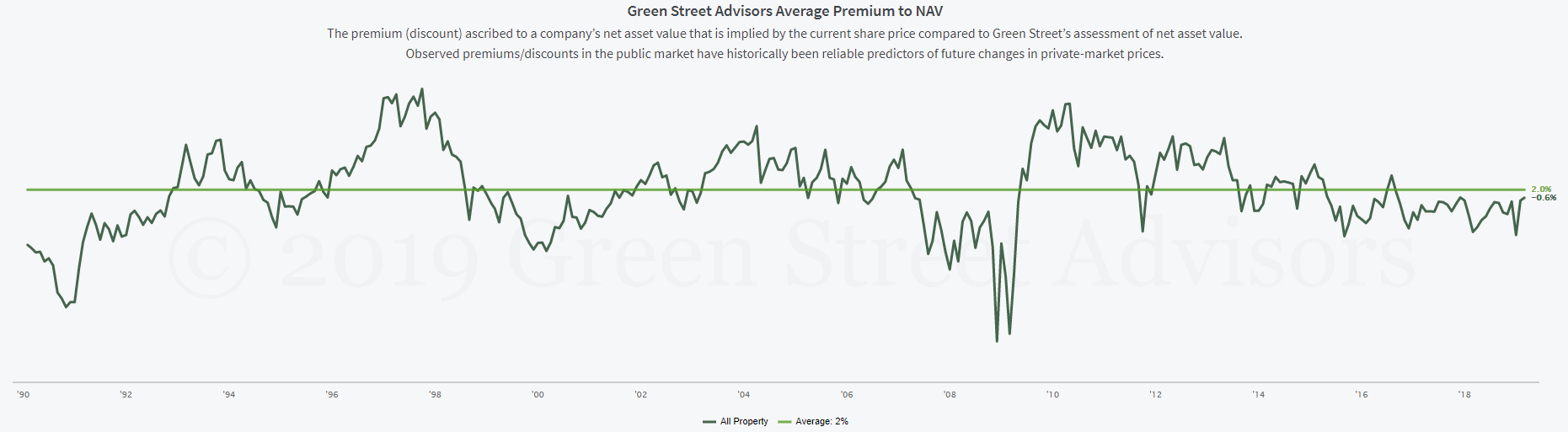
Believe it or not, despite these numerous advantages, REITs are actually trading at cheaper valuations currently than private real estate as the majority of publicly traded REITs trade at discounts to their underlying net asset value. The average discount is small today at 0-5%; but several smaller REITs trade at discounts upward of 30 to 50%.
Building The Portfolio
One easy option for REIT investing is to simply invest in the broader REIT market, utilizing an index fund such as the Vanguard REIT fund (VNQ). However, this means buying every REIT in the index, regardless of its current price, quality, prospects, or management. While “know-nothing investors” (to borrow a term from Charlie Munger) may find this broad diversification useful, we believe (as does Charlie Munger) that using an intelligent analysis of the qualitative and quantitative aspects of each REIT in order to pick and choose the most opportunistic investments will provide the best total returns over the long term.
We spend hundreds of hours researching the REIT market in order to target the highest quality REITs that also are being offered for sale by Mr. Market at low valuations. As a result, we are able to achieve superior dividend yields (currently 8.1% weighted average in our real-money portfolio) at sustainable dividend payout ratios (currently 72.4% weighted average in our real-money portfolio), thereby giving us strong current income and superior total returns over time.
How do we do this? Aside from closely examining balance sheets to ensure a well-laddered debt maturity schedule, examining the quality of the property portfolio and the outlook for the specific property sectors and markets involved, and calculating an estimated fair value and/or NAV for shares (to determine an appropriate buy price), also can do interviews with management teams to see if we can gain any further insight into the strategies and philosophies that will be governing our hard-earned capital while it’s deployed into these securities. This can often confirm our investment thesis or raise red flags that we didn’t notice before that will prevent us from making a mistake and put our long-term financial well being at risk. Finally, we seek to achieve broad diversification across property sectors, with heavier weighted allocations toward those sectors that we deem to be most opportunistic in light of the current market sentiment relative to the macroeconomic environment.
Some of our top ideas at present that reflect our broad diversification include Brookfield Property REIT (BPR), Spirit Realty Capital (SRC), and UMH Properties (UMH).
Closing Notes: Real Estate and REIT Investing Are Wonderful — if you know what you are doing
In a recent survey, 97 percent of investors indicated that they intend to increase capital allocation to real estate in the next 18 months. When you consider what we presented in this article, this is not really surprising. Today, I am strongly convinced that most investors should invest in real estate with REITs to avoid the managerial complications of owning rentals.
Nonetheless, it is important that you know what you are doing. To demonstrate this, consider that the average investor generated only 2.6% annual returns over the past 20 years:

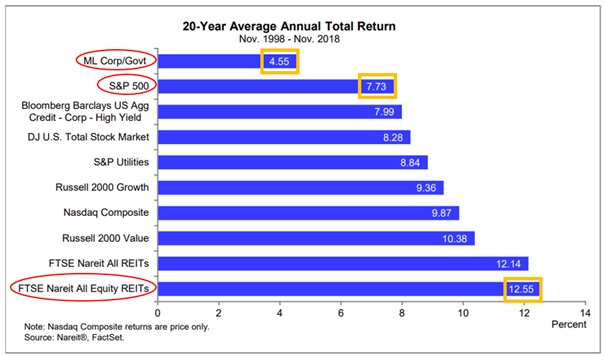
Clearly, the average investor does NOT know what they are doing. In comparison, passive REIT indexes returned 12.5% per year and outperformed almost all other asset classes:
Then taking it one step further, active and more entrepreneurial REIT investors who target market inefficiencies have managed to reach up to +22% annual returns over the same time period:

This is what we aim to do at “High Yield Landlord” by specializing in REIT investing. Our objective is to maximize performance by following an active approach to REIT investing with a special focus on value and high yielding opportunities. So far, the results are paying off and we are outperforming the market by a large margin while enjoying an ~8% average dividend yield.
If you are looking to expand your real estate investments in 2019, take action now and join us before we hike our membership rate! A Few Spots Left!

Disclosure: I am/we are long BPR; SRC; UMH. I wrote this article myself, and it expresses my own opinions. I am not receiving compensation for it (other than from Seeking Alpha). I have no business relationship with any company whose stock is mentioned in this article.
Be the first to comment