
After Newmont Mining (NEM) announced the friendly acquisition of Goldcorp (GG), Barrick Gold’s (GOLD) position of global gold producer no.1 was endangered. The new Newmont should have higher gold reserves, higher gold production and also higher free cash flow than Barrick Gold. Barrick’s response was unexpected. In late February, Barrick proposed an all-stock merger with Newmont. The problem is that it offered a negative premium, arguing that the true premium is hidden in the synergies that should be reached by combining the Nevada assets of both companies. Barrick’s offer was rejected pretty quickly. However, both companies were able to sit down and discuss the potential benefits of the combination of the Nevada assets. The negotiations were productive and the companies were able to announce the creation of a joint venture.
The joint venture (JV) will include the majority of Barrick’s and Newmont’s Nevada assets. Barrick Gold will own 61.5% and Newmont 38.5% of the JV. Barrick Gold will be not only the majority owner but also the operator of the JV that will involve 5 assets of Barrick Gold (Goldstrike, Cortez, Turquoise Ridge, Goldrush, and South Arturo) and 5 assets of Newmont Mining (Carlin, Twin Creeks, Phoenix, Long Canyon, and Lone Tree) (table below). Barrick’s highly prospective Fourmile project hasn’t been included in the JV yet. Also Newmont’s Fiberline and Mike deposits are not included.
Source: Barrick Gold
The key assets are Barrick’s Goldstrike and Cortez mines and Newmont’s Carlin mine. Goldstrike and Cortez have combined reserves of 17.2 million toz gold, and measured, indicated and inferred resources of further 6.1 million toz gold. According to the 2019 production guidance, the two mines should produce together 1.75-1.9 million toz gold at an AISC of $850-900/toz. The Carlin mine has gold reserves of 12.46 million toz gold and gold resources of additional 5.89 million toz gold. In 2019, the mine is expected to produce 895,000 toz gold at an AISC of $1,050/toz.
In the near future, also the Goldrush mine should deliver significant volumes of gold production. Although the reserves at Goldrush are only 1.5 million toz gold, the resources include further 9.4 million toz gold. It is highly probable that in the coming years, a meaningful part of resources will be converted into reserves. It is expected that the Goldrush mine construction should start in 2021, with first gold production in 2022. After full production is reached, Goldrush should be able to produce around 500,000 toz gold per year at an AISC of $640/toz. It means that Goldrush should not only boost the overall gold production of the Nevada JV but also push the gold production costs lower. Moreover, the Fourmile high-grade gold discovery (not included in the JV yet) is located only one kilometer away from Goldrush.
Source: Barrick Gold
Barrick and Newmont claim that the Nevada JV will be the biggest gold producer in the world, with an annual gold production of over 4 million toz and gold reserves of over 48 million toz at a gold grade of 2.26 g/t. The AISC should be in the range of $800-900/toz gold. What is important, the synergies of the combination of Barrick’s and Newmont’s assets should be worth several billion dollars. According to the latest corporate presentation of Barrick Gold, the synergies should be worth around $500 million per year over the first 5 years. The synergies should consist especially of integrated mine planning, consumable discounts and optimization of site-based indirect costs. Significant cost reductions should be reached also by optimizing the trucking routes between mines and processing facilities (map above). The pre-tax NPV(5%) of the synergies is estimated at $4.7 billion. Out of this amount, $2.9 billion is attributable to Barrick Gold and $1.8 billion is attributable to Newmont Mining.
 Data by YCharts
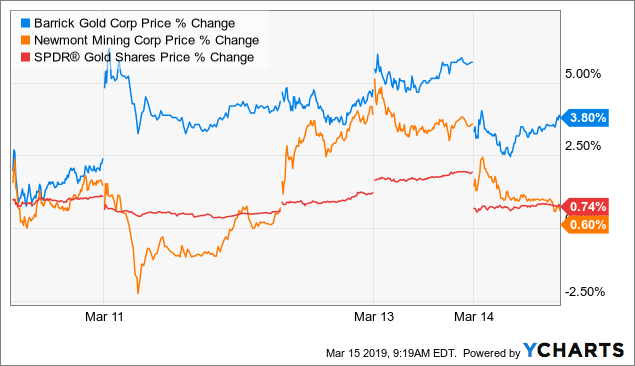
Although the JV looks really good on paper, it hasn’t been reflected by share prices of Barrick Gold and Newmont Mining yet (chart above). The deal was announced on Monday, March 11. On Friday, March 8, Barrick Gold ended the trading day with a market capitalization of $22.65 billion and Newmont Mining with a market capitalization of $18.02 billion. Assuming that the whole NPV of the synergies should be reflected by the share price, Barrick’s share price should grow by 12.8% and Newmont’s share price should grow by 10%, in comparison to the March 8 closing price. However, as shown in the chart above, the JV hasn’t had a significant positive impact on the share prices of the companies yet. Barrick Gold’s shares are up by 3.8% and Newmont’s shares are up by 0.6% since the announcement of the JV, while the gold price represented by the SPDR Gold Trust ETF (GLD) is up by 0.74% over the same time period.
Conclusion
It will probably take some time for the market to reflect the positive impacts of the JV. Especially now when both of the companies are in a transitional period. Barrick Gold completed its merger with Randgold only two months ago and it is in the process of optimizing the operations. It also wants to get rid of some non-core (especially African) assets. Newmont is in the middle of the Goldcorp acquisition. After the acquisition is completed, Newmont also will need some time to fine-tune all of the operations and to get rid of some redundant assets. The positives of the JV will be probably fully appreciated only after the hectic transition periods are over.
Disclosure: I/we have no positions in any stocks mentioned, and no plans to initiate any positions within the next 72 hours. I wrote this article myself, and it expresses my own opinions. I am not receiving compensation for it (other than from Seeking Alpha). I have no business relationship with any company whose stock is mentioned in this article.
Be the first to comment