
It feels like just yesterday that I laid out my Five-Year Plan for achieving what I deemed “Semi-Financial Freedom”. At the time, I had a general idea of the direction I wanted to go with my investments but felt I lacked structure. As a result, I wasn’t holding myself accountable for progressing effectively toward my goals.
Really, without having explicitly stated any goals, it wouldn’t have been able to hit a target which didn’t exist.
As a result, I decided to do just that: I set actual passive income targets for each year from 2015 through the end of 2020. This way I would be able to know whether I was gaining positive momentum or falling behind. It would be a barometer against which I could measure my own performance.
Annual Passive Income
The cornerstone of my investment philosophy is based on dividend growth. I believe that holding high-quality dividend paying equities is the surest way to progressively grow a portfolio over time while mitigating risk of capital loss.
It is the three-pronged dividend snowball of organic dividend increases, dividend reinvestment, and the infusion of fresh investment dollars that compounds a portfolio over time. This is contingent, of course, on owning top-flight companies which are able to reinvest their earnings over the years.
In the two following tables, my favorite column is the third. What you will see is that from the twenty-five different cash-flowing companies in my portfolio, twenty-three of them actually increased their payout in 2018. I feel 92% is solid considering the diversity in my portfolio across many industries. The remaining two companies simply held their dividends steady. This is the consistency I have come to not only enjoy but also actually expect from my investments.
Please note that all Canadian companies are owned in CAD on Canadian Exchanges. I own Johnson & Johnson (JNJ) and The Coca-Cola Company (KO) in CAD within my portfolio, though they each reside on the NYSE. Dollar figures are in CAD unless otherwise stated.
CAD Dividends
| Company | CAD Payments (%) | Div Increase (%) |
| Toronto-Dominion Bank (TD) | 208.80 | 11.67 |
| RioCan Real Estate Investment Trust (OTCPK:RIOCF) | 375.19 | 2.13 |
| The Coca-Cola Company (KO) | 270.85 | 5.41 |
| Johnson & Johnson (JNJ) | 293.14 | 7.14 |
| BCE Inc. (BCE) | 656.15 | 5.23 |
| Canadian Imperial Bank of Commerce (CM) | 63.84 | 4.62 |
| Corby Spirit and Wine Ltd. (OTCPK:CBYDF) | 190.30 | |
| Bank of Nova Scotia (BNS) | 203.15 | 7.59 |
| TELUS Corporation (NYSE:TU) | 144.20 | 6.60 |
| Rogers Communications Inc. (NYSE:RCI) | 105.60 | |
| Fortis, Inc. (FTS) | 233.50 | 5.88 |
| Canadian Utilities Limited (OTCPK:CDUAF) | 263.52 | 10.01 |
| Canadian National Railway Company (NYSE:CNI) | 27.32 | 10.30 |
| Canadian Pacific Railway Limited (CP) | 14.56 | 15.56 |
| Hydro One Ltd (OTC:HRNNF) | 198.60 | 4.55 |
| Chartwell Retirement Residences (OTC:CWSRF) (TSE:CSH.UN) | 58.50 | 2.08 |
| Metro Inc. (OTCPK:MTRAF) | 7.20 | 10.77 |
| Brookfield Renewable Partners L.P. (NYSE:BEP) | 159.01 | 4.81 |
USD Dividends
| Company | USD Payments ($) | Div Increase (%) |
| Waste Management, Inc. (WM) | 79.08 | 9.41 |
| McDonald’s Corporation (MCD) | 74.80 | 14.86 |
| Yum! Brands, Inc. (YUM) | 47.76 | 20.00 |
| Yum China Holdings, Inc. (YUMC) | 13.94 | 20.00 |
| PepsiCo Inc. (PEP) | 29.48 | 15.22 |
| Walmart Inc. (WMT) | 26.40 | 1.97 |
| Visa Inc. (V) | 7.50 | 28.21 |
I earned $3,473.43 CAD and $278.96 USD this year from dividends. On a currency-neutral basis, that amounts to $3,752.39. Converted to USD, this would equate $2,876.01. When including the $554.53 I raked in from interest on idle cash, my passive income hit a record high $4,306.92 through calendar 2018.
This marks the completion of the third full year of my Five-Year Plan. I’ve taken the original table from my first article on the subject and adjusted it for the actual totals, so you can see how I’ve been progressing:
| Year | Age | Target Annual (Div + Int) |
Actual Annual (Div + Int) |
Target Exceeded (%) |
| 2015 | 28 | 2,000 | 2,191.63 | 9.58 |
| 2016 | 29 | 2,500 | 2,713.16 | 8.53 |
| 2017 | 30 | 3,100 | 3,341.80 | 7.80 |
| 2018 | 31 | 3,700 | 4,301.71 | 16.26 |
| 2019 | 32 | 4,400 | ||
| 2020 | 33 | 5,100 |
The “Div + Int” calculation effectively represents the total passive income I earned by adding the dividends from above to the total interest I earned each month on idle cash sitting in a high-interest savings account.
I have managed to exceed my targets in each year, generally by a considerable sum. I was tracking for the first three periods with a 7-10% outperformance on my target, but then had an explosion of activity this year which has me feeling very comfortable that I’ll be able to hit the 2019 and 2020 figures as expected.
I will keep an eye on this through the year and, at the end of 2019, decide if it would be worth simply making an adjustment on-the-fly to raise the bar.
Market Activity
It was a prolific year for me in terms of pulling the trigger on buying stocks. I committed capital on 18 occasions in dividend-paying equities. Quite frequently, I was simply doubling down on something I already owned rather than initiating a new position.
This table shows the companies I purchased and the total capital outlay for each:
| Company | Total Cost ($) |
| CBYDF | 2,127.75 |
| BNS | 5,941.70 |
| FTS | 3,383.20 |
| CDUAF | 3,291.75 |
| HRNNF | 2,204.20 |
| MTRAF | 866.95 |
| BEP | 7,388.15 |
| AbbVie Inc. (ABBV) | 1,766.75 USD |
The final sum is $26,970.45 in currency-neutral terms which far exceeds the amount I’ve invested in a single year in the past. I don’t suspect I will hit this number again through 2019, though that will be subject to how volatile the market is; I like to take advantage when it declines.
Of the companies above, all made dividend payments this year in my portfolio except ABBV since I bought it at the end of the year and should receive my first payment in February.
The only dividend payer I sold out of was Jean Coutu which was amalgamated into MRU. I bought a few MRU shares, so I would still have some exposure to Jean Coutu which I regard as a high-quality pharmaceutical retailer.
I will cover my venture into cannabis investments later in this article.
Financial Milestones
It turns out that 2018 was a great year for hitting milestones.
The first one came back in March when I finished payments on my iPhone 5S. Even when I bought this phone two years ago, it was already an “outdated” version as the iPhone 6 was already on the market. That was okay with me as I really use my smartphone just for calling and texting. I will occasionally use it to catch up on stock market/investing articles if I am by myself and in a lineup, for instance.
As a result, it made more sense at the time to simply take an older model at no cost. At this stage, the iPhone is still in full working order and so I’ll continue to simply use it. I did call my cell phone provider once it was paid off and negotiated a lower rate. Fifteen dollars a month in savings isn’t a whole lot, but I prefer it to be in my pocket.
The second financial milestone I hit this year was by paying off my 2012 Chevrolet Silverado. I covered this in an article at the end of September where I outlined that this will ultimately result in around $560 per month in savings. I have definitely felt the impact of this and have been diverting all of the cash flow since that time into investments.
As I indicated with my phone, I am very comfortable driving an older model and enjoy knowing that the truck I am driving is now paid off. Consequently, I am entirely out of debt and that’s a comforting fact. The goal of studying personal finance is, at its root, about living a lifestyle based on one’s own values rather than in pursuit of money. By not feeling compelled to keep up with the Joneses, I am able to further fortify my financial castle by choosing to remain debt free rather than “upgrading”.
My Portfolio Performance vs. Market Performance
I have stated in the past that I am not concerned whether I am outperforming market benchmarks. The fact of the matter is that my focus is very different from what institutional investors are after. It doesn’t matter if I “beat other people” so long as I hit my own goals along the way.
The real win, in the end, will be whether I am able to someday support myself entirely through passive income from investments I have made over the years.
Nevertheless, I took a look on December 31 at the “Performance” section of my online discount broker. I have been with my current broker for more than three years but less than five and so I was able to quickly get a snapshot of my performance since that time.
Here are the results:
Over a three-year window, I have outperformed the S&P 500 by roughly half a percent annualized, net of fees and commissions. When comparing my portfolio to the S&P/TSX Composite Index, I have actually blown it out of the water by over 5% annually over the past three years!
While it has been shown that mutual funds/actively managed funds (the ones managed by professionals) generally underperform the market, particularly when accounting for fees, I have been able to beat the market from the comfort of my living room.
How is it possible for a “home gamer” to beat professionals with teams of staff and all of their top tier investment research? Isn’t “big money” supposed to be the “smart money”?
Fundamentally, my strategy is built around owning the best companies in the world, reinvesting the dividends, and avoiding fees. Since I’m not trying to play the same game as the professionals, I don’t need to try to beat them at it. I don’t care about the “velocity of money” and making fast trades in and out of stocks.
As Warren Buffett says, my favourite investment holding period is forever. When your portfolio is compromised only of quality, there isn’t the need to take part in manic buying-and-selling.
U.S. Corporate Tax Cuts and Dividend Increases
One of the prevailing themes through 2018 was an uptick in the size of dividend increases. Many companies cited the corporate tax cuts in the U.S. as one of the drivers of these bumps. As a shareholder, I have to say this came as a very welcome reward for holding shares in top-notch companies.
I received double-digit dividend increases from a whopping ten of the twenty-five companies that paid me this year, with three of them hitting 20% or higher. While I don’t expect the rate of increases to continue at this pace moving forward, it was a positive development all the same.
Canadian Legalization of Marijuana
One of the hottest topics in the world of speculative investing this year was the legalization of recreational marijuana use in Canada. This came to fruition in October amid plenty of fanfare.
As I mentioned in my September Portfolio Update, I previously liquidated all of the cannabis positions I had purchased at a considerable profit and reinvested the gains into dividend growth equities.
It turns out that my timing was fortuitous as since legalization, the three companies I held have all taken a considerable dip. Here’s a chart from Yahoo! Finance:
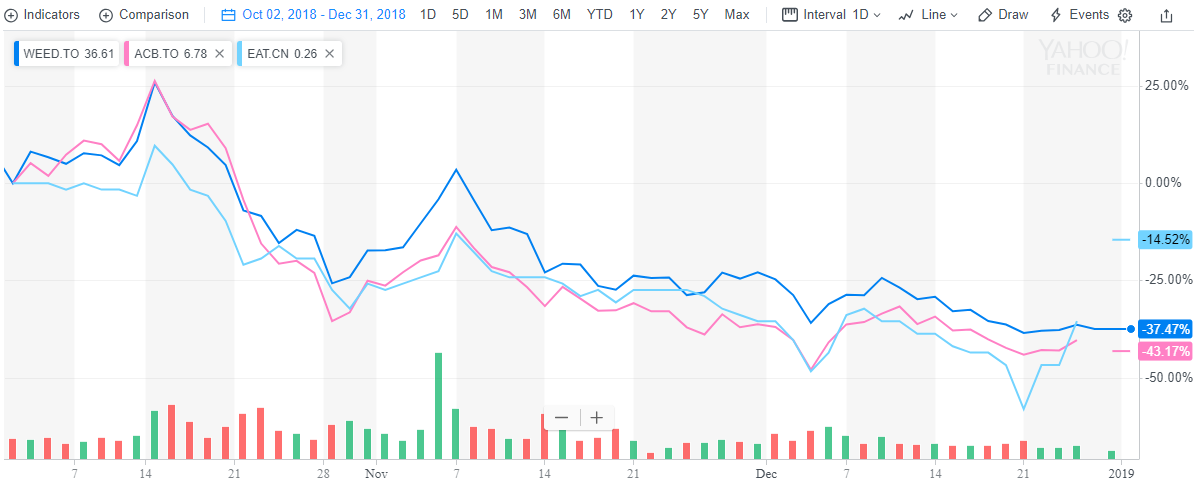
At the end of the day, investing in non-cash flowing investments is basically speculation and, in sectors like cannabis, feels as much like gambling as anything else. The hope is that the company will rise and the “investor” will be able to sell to someone else who thinks it will go higher still. It’s called the “Greater Fool Theory”, which basically says you’re hoping a bigger fool than yourself will eventually be willing to pay more for something that you did.
That’s outside my general realm of investing, but it made sense late last year to get involved as the hysteria was absolutely insane and did allow me to more than double my investment in a short period of time. While it worked out this time, this isn’t the sort of behavior I would like to continue.
Conclusion
It was a great year for my portfolio. Through 2018, I was able to hit the highest passive income gains both in terms of absolute dollar value and percentage gain since beginning my Five Year Plan.
We’ve all heard the old proverb that you need to plan your work and work your plan. I believe this to be true. Having goals allows a clearer vision of what to aim for.
I hit two financial milestones this year; one minor and the other significant. Based on this, I am now entirely debt free and loving the fact that I can funnel more cash flow toward my investments which will accelerate the aforementioned dividend snowball. It took six years to pay off my truck and I’ll be happy to be driving it for at least six more.
The corporate tax cuts south of the border provided a wonderful boon to my dividend growth which I’ll be able to parlay into greater dividend reinvestment in the coming year. I don’t take it for granted when I’m given some help along the way and will be sure to make the most of it.
Consolidating my portfolio back into dividend growth investments after a brief foray into the cannabis sector is the right move for me at this time. With that said, it is important to not have tunnel vision and so I will still keep an eye out for whatever else is coming down the pipeline that could provide a boost to the portfolio.
Thank you for continuing to follow my journey.
– Ryan
What do you think of the progress I’ve made on my Five Year Plan? What goals have you set for yourself?
Disclosure: I am/we are long TD, RIOCF, KO, JNJ, BCE, CM, CBYDF, BNS, TU, RCI, FTS, CDUAF, CNI, CP, HRNNF, TSE:CSH.UN, MTRAF, BEP, WM, MCD, YUM, YUMC, PEP, WMT, V, ABBV. I wrote this article myself, and it expresses my own opinions. I am not receiving compensation for it. I have no business relationship with any company whose stock is mentioned in this article.
Be the first to comment