In the previous article, we have looked at Seadrill Partners’ (SDLP) third-quarter fleet status update. Now, it’s high time to dig into the company’s third-quarter earnings results and key commentary during the conference call.
In the third quarter, Seadrill Partners recorded revenues of $206 million and a net loss of $19 million. The key driver for the loss was interest expenses, which increased significantly following the renegotiation of the company’s debt terms. Back in 3Q 2017, quarterly interest expenses were $47 million, while they were $69 million in 3Q 2018. From a cash flow perspective, things are still going well for the company as it enjoys high-margin contracts of the semi-sub West Capricorn and drillships West Auriga and West Vela. Not surprisingly, the company’s cash position remains strong at $882 million, while the long-term debt, the main problem of Seadrill Partners, stands at $2.9 billion.
Now that we’ve had a quick overview of the company’s current financial situation, let’s turn to key moving parts. The survival of Seadrill Partners depends on the company’s ability to push the maturity of its debt far into the future, preferably to 2025+. For this to become reality, the company needs cash flows to service the debt. As discussed in the previous article about Seadrill Partners’ fleet status report, the company has two major drillship contracts at a high dayrate of $575,000 that end in late 2020. However, it will need to replace them when the time comes as well as find jobs for other rigs. Thus, Seadrill Partners needs 1) more rig employment and 2) cash positive rig employment.
It is not surprising that the company made the following comment during the earnings call: “[…] now is actually the time to be patient and pick your spots and get the right contract versus just any contract“. This is true for Seadrill Partners because the company’s main problem is debt, and to solve this problem, it must have the cash flows that will be sufficient enough to cover the interest payments.
In this light, Seadrill Partners is not interested in the uptick of asset value that happens when a rig goes from a stacked state to a working state. Instead, it is interested in putting rigs at cash flow positive contracts in 2020 when the active part of negotiations with lenders will be conducted. As we have discussed in “Thoughts On Offshore Drilling In Light Of Recent Oil Price Dynamics” and “More Thoughts On Offshore Drilling Stocks In Light Of Recent Oil Price Dynamics“, the year 2019 is looking like another year of pain for the ultra-deepwater segment, so Seadrill Partners does not necessarily has to rush its unemployed floaters back to the market right now given its priorities.
Another important remark in the earnings call was made regarding West Leo, a harsh-environment semi-sub that is currently cold stacked in Spain. The company’s comments were not encouraging at all: “[…] although it’s got a harsh environment haul, it has been working in benign environment for some time. So, consider this is a benign environment cold stack semi, which are not the most desirable units in the market”.
If Seadrill Partners itself views West Leo as a benign environment semi-sub, the rig is out of the game for many months to come. According to Bassoe Offshore, current estimated dayrate for a sixth-gen benign environment semi-sub is $145,000, which means there is no sense to unstack a cold stack unit.
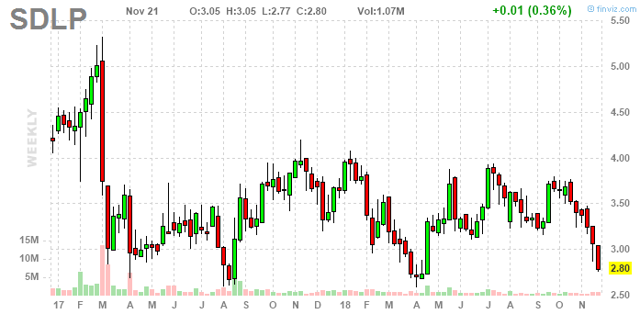
Previously, Seadrill Partners’ units proved to be a great range play below $3.00. If the oil prices rebound, there’s a significant chance that such a move will be repeated. Due to company’s cash position, there is no real risk to distribution in the short-term, and the company’s units are now flashing on all yield-hunters’ radars.
However, the closer we get to 2020, the riskier this range play becomes. Seadrill Partners needs upside in dayrates or it will have trouble servicing its debt post the completion of the high-margin era contracts. This upside (or, in fact, any upside) is yet to emerge on all floater segments outside of the North Sea. In short, the trick with range play may work one more time, but this time the traders and especially investors should be more cautious because the clock starts ticking for the company – it needs dayrates to rise materially the next two years.
If you like my work, don’t forget to click on the big orange “Follow” button at the top of the screen and hit the “Like” button at the bottom of this article.
Disclosure: I/we have no positions in any stocks mentioned, and no plans to initiate any positions within the next 72 hours.
I wrote this article myself, and it expresses my own opinions. I am not receiving compensation for it (other than from Seeking Alpha). I have no business relationship with any company whose stock is mentioned in this article.
Additional disclosure: I may trade any of the above-mentioned stocks.
Be the first to comment