This research report was produced by The REIT Forum with assistance from Big Dog Investments.
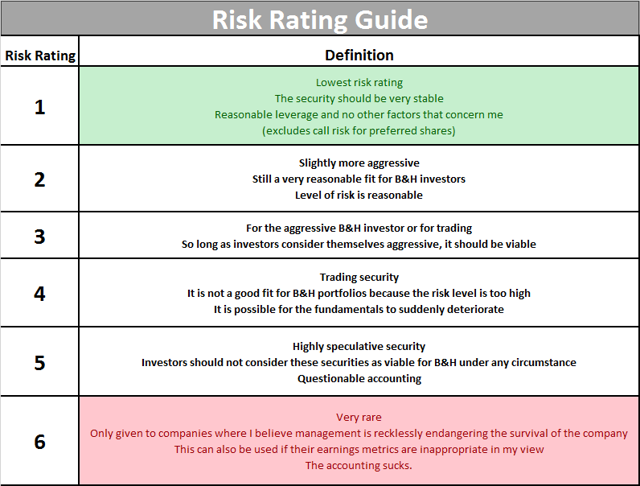
Dynex Capital (DX) has two preferred shares with a yield around 8%: DX-A (DX.PA) and DX-B (DX.PB). When hunting for yields over 8%, these are 2 of the best in the sector. DX preferred shares carry a risk rating of 3 which makes them a good fit for the more aggressive buy-and-hold investors.
Source: The REIT Forum
Shares of DX-A are closer to the buy than DX-B at recent prices.
For investors interested in The REIT Forum’s preferred share ratings, see my guide to preferred shares. I also have a guide for preferred share dividend captures.
DX common stock
The following section will only be a quick note on the company. This is so that investors have an idea of the underlying portfolio for the preferred shares. We do cover mortgage REIT valuations extensively on The REIT Forum and have also published numerous articles on mortgage REIT common stocks. We believe the mortgage REIT common stocks carry too much risk for conservative investors. We do cover most of the preferred shares in the sector and believe many of them to be a great fit for buy-and-hold investors. Some preferred shares carry a high-risk rating, but they still carry less risk than the common stocks. We cover 50+ preferred shares on The REIT Forum with comparable pricing, buy ratings, and risk ratings.
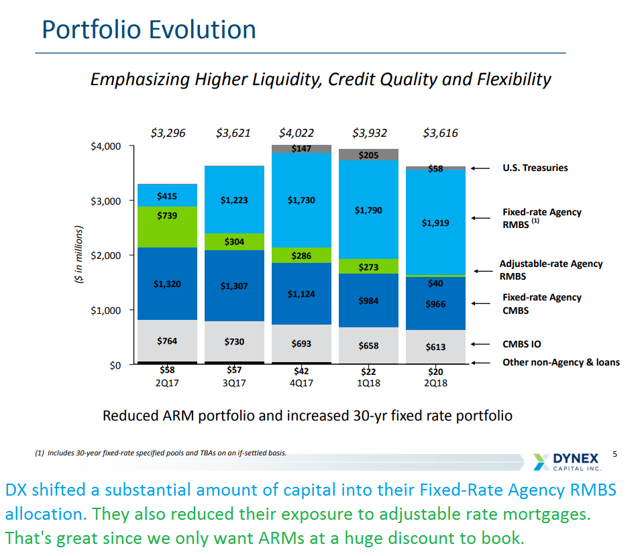
Dynex Capital is a small mortgage REIT with the right idea. They’ve been repositioning their portfolio to move capital into the 30-year fixed-rate agency RMBS and away from other asset classes.
Source: DX
DX currently trades at a price-to-book ratio lower than the sector average.
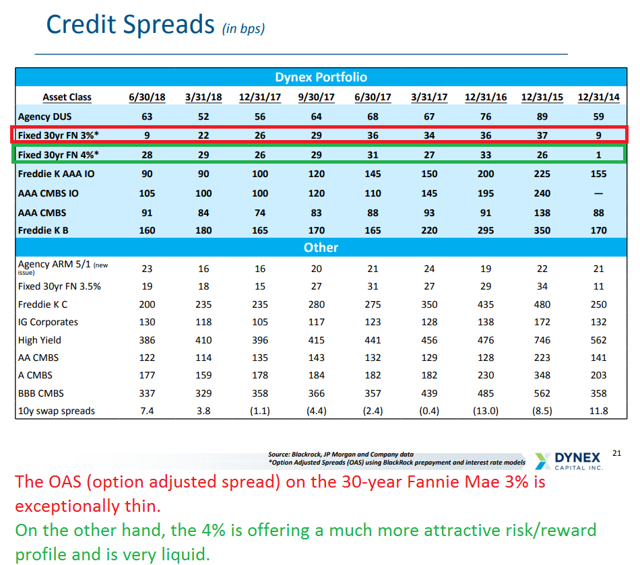
DX provides another great slide that demonstrates why this change in their allocation makes so much sense:
Source: DX
This would be a good time to point out that most of the other categories are pretty close to the tightest levels seen in the last few years.
If anyone noticed that the agency ARMs (top of the “other” category) are trading at wider spreads than normal, congratulations. It looks like the ARMs are offering a great risk/reward, but the market for ARMs isn’t as liquid as it was before. The bid-ask spread on the ARMs can get surprisingly wide. The high score there depends on whether you are using the low bid or the high ask. Consequently, investors shouldn’t rely on the spread on ARMs being as attractive as it looks here. Fortunately, DX has an incredibly small allocation to that space today.
Dynex Capital Preferred Shares
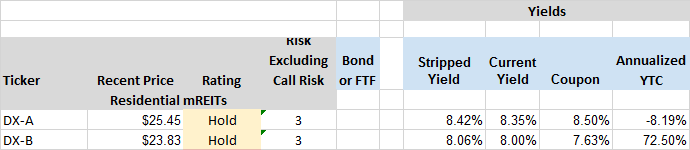
Here are the two preferred shares from DX:
Source: CWMF’s subscriber spreadsheet (subscription required for 50+ preferred shares and baby bonds with comparing prices)
While both DX preferred shares are within the hold range, DX-A has the most attractive stripped yield by a large margin. For a risk rating or 3, a yield of 8.42% is very attractive. However, because of call risk we still view DX-A as a hold. There is no more call protection left on the calendar and shares of DX-A have a negative worst-cash-to-call:

There is a material amount of accumulated dividend which should be subtracted from the purchase price. The stripped yield we use accounts for dividend accrual.
Dividend information
Preferred shares accrue their dividends throughout the month (if paying monthly) or throughout the quarter (if paying quarterly). We keep a running tally to determine how much dividend has accrued at any point. The value is referred to as the amount accumulated.
We can also measure their progress. That is how far the shares are towards their next ex-dividend date. We measure it by evaluating what percentage of the time period has passed. For instance, if there are 91 days between the ex-dividend dates, then if 45 days have passed we would have just under 50% dividend accrual.
The next ex-div. date shows us the upcoming ex-dividend date. Remember that the ex-dividend date is not the day the company makes the payment. The ex-dividend date is used to determine who gets the payment.
When shares begin trading in pre-market trading on the ex-dividend date, they can be sold without the buyer getting the dividend. For instance, if the ex-dividend date is 6/21, then an investor who owns the shares before trading begins on 6/21 gets the dividend. A buyer on 6/21 does not get the dividend.
Companies rarely announce their preferred share ex-dividend date months in advance. We know roughly when the ex-dividend date will be, but we aren’t certain on the exact date. You can check “is date projected?” to see if we have the exact date released by the company yet. If we do, the cell is blank. If we don’t have a company release yet, then the cell says “Projected.”
The next call date is the earliest the shares can be called, but the company is not obligated to call them. When the shares are initially issued, they will be protected from calls for some period of time. Often that period is between 5 years and 10 years.
Most preferred shares require 30 days’ notice on a call, so the next call date will either use the date call protection ends or 30 days from the latest weekend update by The REIT Forum, whichever is longer.
Final thoughts
The very high coupon rate on DX-A provides a stronger floor but the lack of call protection provides a ceiling. Consequently, DX-A should trade in a pretty tight range. DX-B doesn’t have call protection either, but it trades at a discount because it has a much lower coupon rate. It is also in the neutral range. Absent any major movement in share prices or Treasury prices, we’ve got a buy rating on the common shares of DX.
Note: Liquidity for DX-A is a bit thin. When we prepared this, the last traded price was $25.43. On Thursday and Friday, shares of DX-A rallied and closed higher. We suggest only using limit-buy orders on these preferred shares (and limit-sell when selling). There is still a significant probability of shares dropping back down to the prior range as the last 2 days appear to be an aberration. We find these shares are often trading within a range and using limit-buy and limit-sell allows investors to avoid paying too much or selling for too little.
If you enjoyed reading this article and want to receive updates on our latest research, click “Follow” next to my name at the top of this article.
Disclosure: I am/we are long DX.
I wrote this article myself, and it expresses my own opinions. I am not receiving compensation for it (other than from Seeking Alpha). I have no business relationship with any company whose stock is mentioned in this article.
Be the first to comment