Ignoring the steep drop in value of its much larger parent company, Tencent (OTCPK:TCEHY), which is on and off the largest technology company in China by market cap, Tencent Music (TME) has forged ahead with its highly anticipated IPO. A strong opening from overseas rival (and part-owner, thanks to a stock swap) Spotify (SPOT) has led observers to increase their estimate of Tencent Music’s valuation to a range of $29-31 billion. The company has not yet set a pricing range for its IPO, but judging by its massive user and revenue base, such a valuation wouldn’t be unreasonable.
Tencent Music is the largest music streaming service in China. With ~800 million monthly active users (“MAUs”), Tencent Music operates at a scale that’s roughly ~4x that of Spotify, which most recently guided to 199-207 million MAUs for the current fiscal year.
Tencent Music is also growing much quicker than its Swedish rival – in the first six months of the current year, Tencent Music achieved 92% y/y revenue growth, also much faster than Spotify’s ~30% y/y music growth.
There’s no doubt that Tencent has extremely strong fundamentals and a tremendous growth narrative – the major risk in investing in this IPO is China itself and the damage that the U.S.-China trade tensions have inflicted upon the Chinese technology stocks. The so-called “BAT” stocks, consisting of Baidu (BIDU), Tencent, and Alibaba (BABA), with JD.com (JD), sometimes included in the group are all down year-to-date, despite driving much of the Chinese market’s returns in 2017:
BIDU data by YCharts
It will be difficult to distance Tencent’s IPO from the fortunes of its parent company and its peers in Chinese tech. As such, Tencent Music’s IPO will likely be executed at a discount to fair value – which presents a compelling opportunity for investors willing to brace the current China volatility and look to the company’s long-term expansion potential.
Changing the music landscape in China
Music has always been a tricky business in China, where the piracy problem is perhaps more pronounced than in other country in the world. According to Tencent Music’s F-1 filing, the music industry in China was “undeveloped” until recently, and Americans spent more than 45x on music than Chinese, despite China having a population that’s ~5x greater.
Tencent Music, on the other hand, is hoping to revolutionize the paid music streaming industry in China. The company describes its product as follows:
“Our platform is an all-in-one music entertainment destination that allows users to seamlessly engage with music in many ways, including discovering, listening, singing, watching, performing and socializing. On our platform, social interactions such as sharing, liking, commenting, following and virtual gifting, are deeply integrated in our products and highly complementary to the core music experience, thereby enhancing our user experience, engagement and retention. As a result, we have built our platform into not just a music streaming platform, but a broad community for music fans to discover, listen, sing, watch, perform and socialize.”
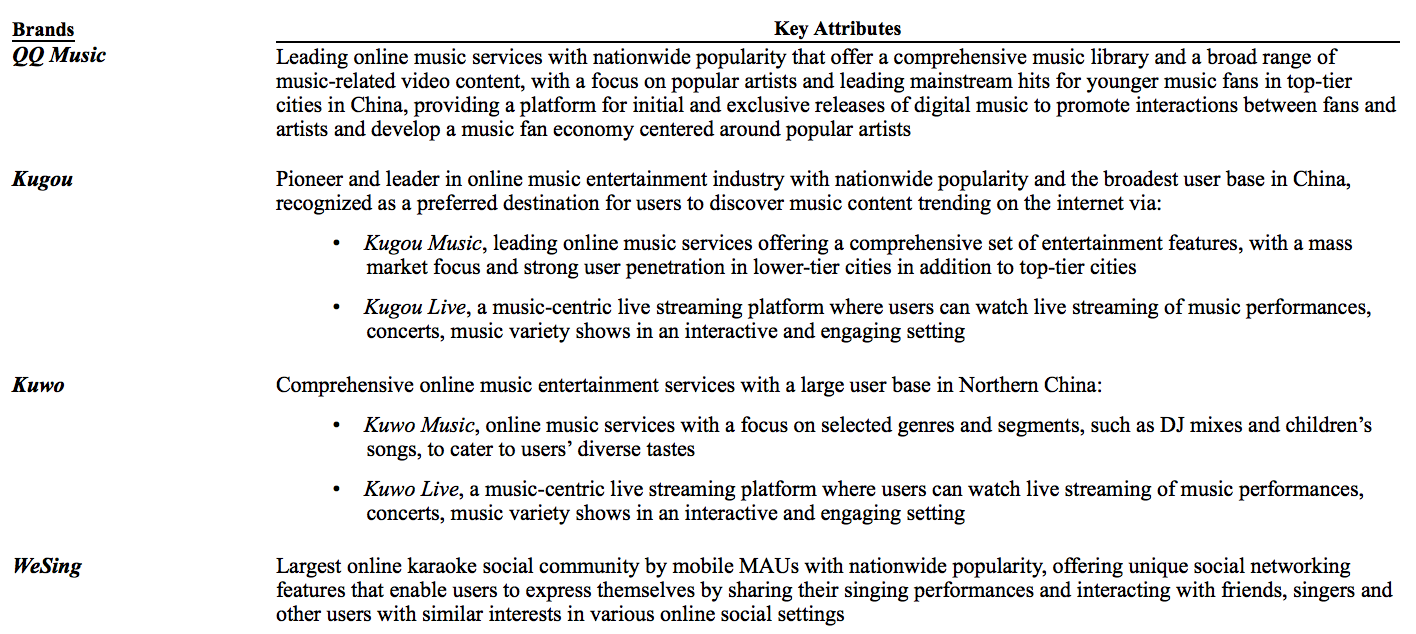
Unlike Spotify, Tencent itself operates four distinct applications: QQ Music, Kugou Music, Kuwo Music, as well as WeSing, a karaoke app. These four apps together make up the Top 4 music applications in China, and together, they serve 800 million MAUs – more than half of China’s population.
The table below, taken from Tencent Music’s F-1 filing, highlights the distinction between the company’s four applications:
Figure 1. Tencent Music applications
Source: Tencent Music F-1 filing
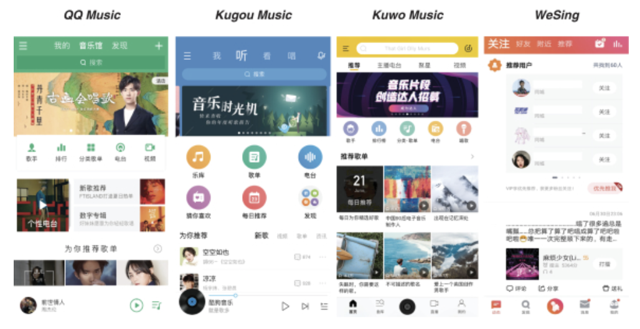
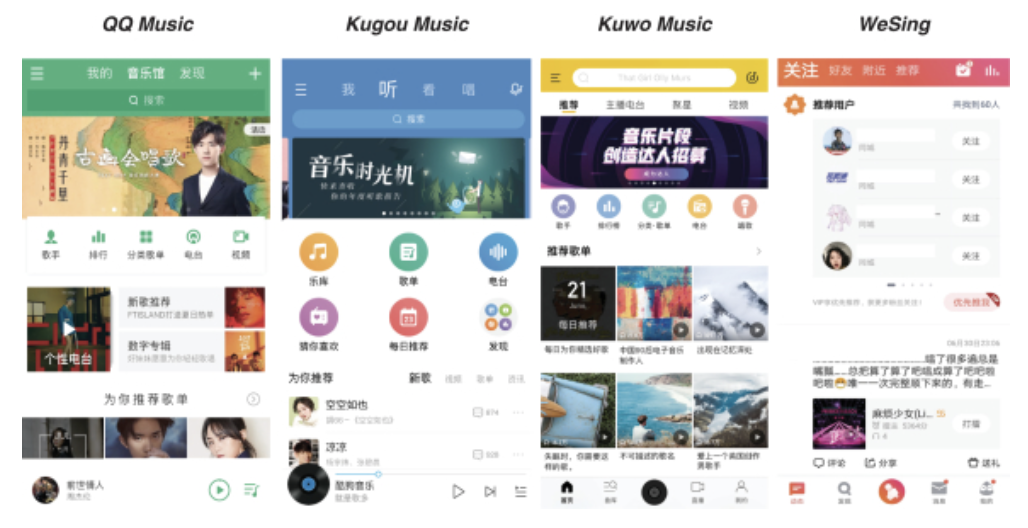
The screenshot below, also taken from the F-1 filing, showcases the UI of each application:
Figure 2. Tencent Music application interfaces
Source: Tencent Music F-1 filing
Like other music applications, Tencent’s apps offer a wide variety of playlist creation, music discovery, recommendation, and music sharing/social media features.
Tencent Music, needless to say, operates the largest content library in China’s music industry and is a promoter of artists’ copyrights. Across all of its platforms, Tencent Music has a library of 20 million tracks from 200 domestic and international music labels. Tencent additionally operates a platform for user-generated content, which has soared in popularity – WeSing has risen to become one of the most popular social media applications in China, with millions of daily users.
MAU and paid user growth
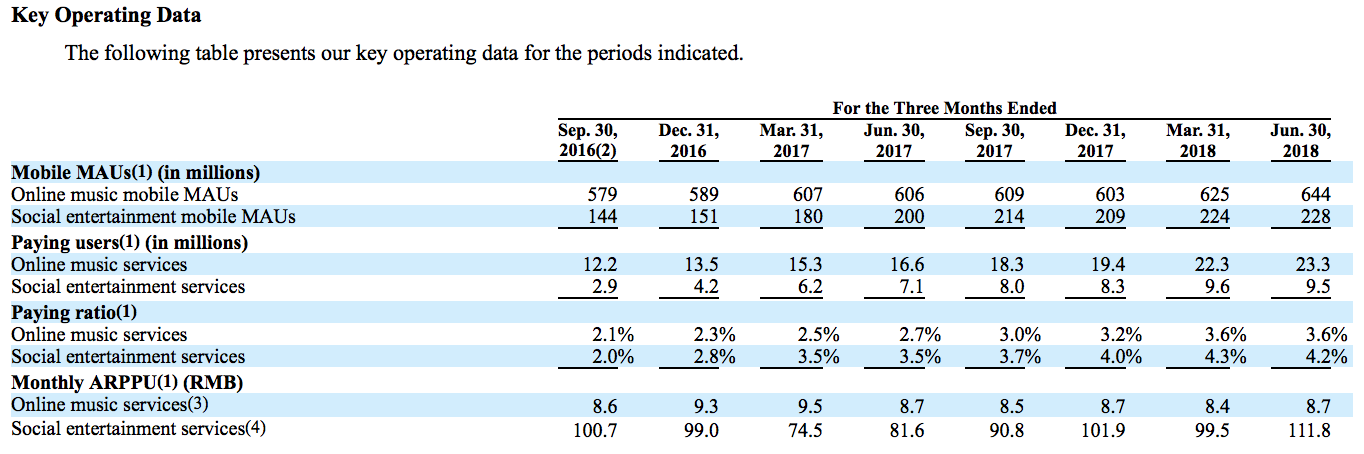
In a relatively short time, Tencent has managed to capture a large swath of the Chinese market, and as such, MAU growth has begun to slow down. In the June quarter, growth in MAUs hit just 8.2%.
Figure 3. Tencent Music MAU trends
Source: Tencent Music F-1 filing
Where Tencent’s opportunity lies, however, is in its paid user growth. Paid users hit 32.8 million in 2Q18, up 37% y/y from 23.7 million in 2Q17, as shown in the chart above. The “paying ratio” has also jumped to 3.6% for online music services and 4.2% for social entertainment services (karaoke), which is 90bps and 70bps higher than 2Q17, respectively. Like Spotify, Tencent operates both free ad-supported and subscription tiers, but its penetration with its subscribing users is much lower than Spotify, for whom about half of its MAUs are subscribers.
Part of that shift is cultural – as Tencent Music itself acknowledged, the concept of paying for music in China is still relatively novel. Tencent Music also notes that its paying user ratio, relative to gaming and social network apps, is also very low, indicating plenty of room for expansion. As the Chinese middle class expands, however, and subscription services proliferate into the norm, Tencent Music can experience tremendous growth. It also enjoyed a highly engaged user base, which spends an average of 70 minutes daily across the Tencent Music applications that is conducive to converting more users into paid subscribers.
Financial overview
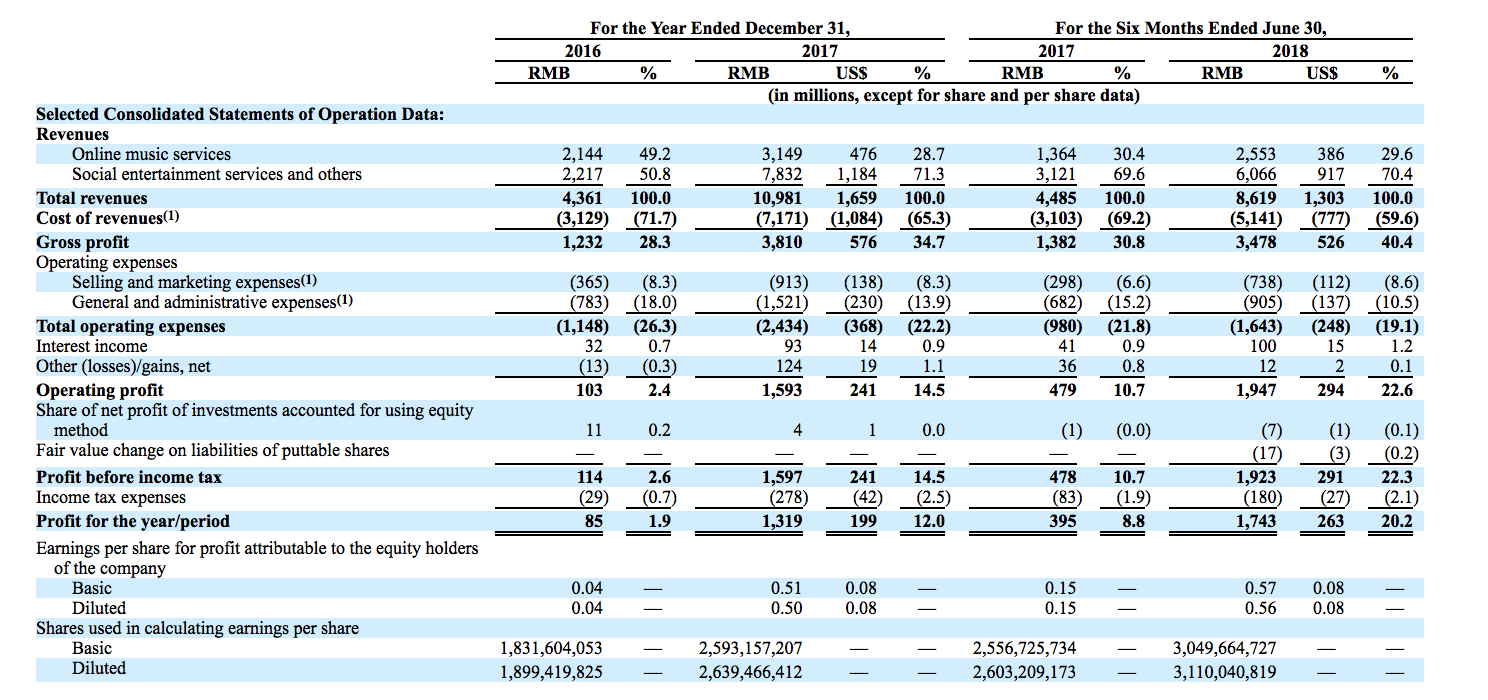
Here’s a look at Tencent Music’s financials:
Figure 4. Tencent Music historical financials
Source: Tencent Music F-1 filing
Revenues in the first half of FY18 grew 92% y/y to ¥8.62 billion (the equivalent of $1.30 billion), nearly overtaking revenues in all of FY17. As previously noted, the majority of this growth was driven by a rapid increase in the company’s paid user base.
To date, a majority of Tencent Music’s revenues are still derived from social entertainment services, which are the fees that Tencent charges from live music streaming, karaoke, and music-related merchandise. Paid subscriptions make up the bulk of “online music services” revenues, while advertising comprises of a small mix of the total.
Like Spotify, the majority of Tencent Music’s costs lies in content fees.
Figure 5. Tencent Music cost of revenues breakdown
Approximately ¥4.5 billion (or about $680 million) went to content licensing and royalty fees in the first half of 2018, comprising a little over half of Tencent Music’s revenues. Still, it’s important to note that Tencent Music generated a 40.4% gross margin in 1H18, much better than 25.3% for the same time period for Spotify, which pays out a greater portion of its revenues in content fees than Tencent Music.
Note also that Tencent Music generated an operating profit of ¥1.95 billion in 1H18, representing a strong operating margin of 22.6%. This, too, stands in stark contrast to Spotify, which generates operating losses. Though these platforms are not in direct competition (Spotify doesn’t operate in China), the fact that Tencent Music is growing much faster than Spotify and has already hit positive operating margins suggests that it operates a far more sustainable platform.
Key takeaways
Tencent Music is easily the most exciting IPO to come out of China this year, if not one of the most exciting IPOs of the year overall. Relative to Spotify, Tencent Music offers investors much faster growth and positive operating margins – whereas decelerating revenue growth and continued losses have been a pain point for Spotify during its most recent earnings releases.
The greatest challenge in this IPO, of course, is a sour investment climate in China overall. Long-term investors who can stomach an extended period of volatility, however, can benefit from investing in Tencent Music early on in its path to becoming another Chinese technology giant.
Disclosure: I am/we are long BIDU, JD.
I wrote this article myself, and it expresses my own opinions. I am not receiving compensation for it (other than from Seeking Alpha). I have no business relationship with any company whose stock is mentioned in this article.
Editor’s Note: This article discusses one or more securities that do not trade on a major U.S. exchange. Please be aware of the risks associated with these stocks.
Be the first to comment