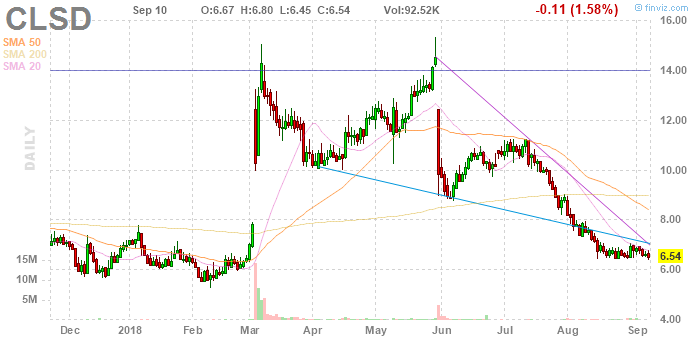
Clearside Biomedical (NASDAQ:CLSD) was founded in 2011 and is based in Alpharetta, Georgia.
(Source: Finviz)
The company is developing triamcinolone acetonide (TCA), CLS-TA (a corticosteroid) injection administered in the suprachoroidal space of the eye in various eye conditions. Compared to the intravitreal injections, administering the steroid in the suprachoroidal space has the potential for fewer side effects like an increase in eye pressure and increased bioavailability at the intended site.
Macular edema due to retinal vein occlusion, RVO, is currently treated with an anti-vascular endothelial growth factor, VEGF agent like Eyelea as a first line agent. Steroid eye implant (OZURDEX) or intravitreal TCA injections are second-line therapies. Chronic anti-VEGF injections are needed in many of these patients. The company believes that using a combination of intravitreal anti-VEGF agent and suprachoroidal CLS-TA, a faster and better resolution of macular edema due to RVO can be achieved, which may be desirable to recover the visual loss. The target market is 16 million RVO patients globally and approximately 2.2 million RVO patients in the U.S. (per the company’s 10-K).
The 8-week data from the first phase 3 trial (SAPPHIRE) in treating macular edema due to RVO is expected in Q4 this year (a big binary event for the stock price). This is the first of the two phase 3 trials being conducted for regulatory application in this indication. It is a multicenter, randomized, controlled, masked trial and will enroll 460 subjects. The experimental arm will test a combination of suprachoroidal CLS-TA and intravitreal Eylea injections versus the control arm of intravitreal Eylea alone. The primary endpoint is the proportion of subjects showing 15 letters or more improvement from the baseline in ETDRS score after 2 months. The secondary endpoints are: mean change from the baseline in best corrected visual acuity at 6 months based on ETDRS score, and the mean change from the baseline in central subfield thickness at 6 months (based on spectral domain optical tomography). The trial enrollment was completed in June this year.
The phase 2 trial (TANZANITE) in this clinical indication achieved statistical significance by a narrow margin (p=0.04 at 2 months, the similar duration of follow-up as the phase 3). The phase 2 trial enrolled a similar patient population based on the inclusion and exclusion criteria. It enrolled 46 subjects, 23 in each arm. The two treatment arms (including the control arm) were similar to the SAPPHIRE phase 3 trial. The primary endpoint was identical to that in the phase 3 SAPPHIRE trial (61% subjects in the treatment arm achieved 15 letters or more improvement in visual acuity versus 39% in the control arm at 2 months, p=0.04).
Earlier this year, a phase 3 trial (PEACHTREE) of CLS-TA in treating macular edema due to non-infectious uveitis achieved statistical significance by a wide margin (p<0.001). However, we have to consider that the control arm in this trial was a sham procedure, not an approved drug like the SAPPHIRE trial. Using an approved, widely used drug as a control arm increases the bar of success in clinical trials rather than using a placebo as the control. The target market in this indication is smaller (115,000 patients in the U.S.). Based on the efficacy and safety shown in phase 3 (a single phase 3 is needed), the company is planning to file an NDA in year-end 2018.
The third indication for CLS-TA is diabetic macular edema, which affects 1.1 million U.S. patients. A phase 2 trial using a similar treatment and control arms as the phase 3 SAPPHIRE trial (suprachoroidal CLS-TA+intravitreal TCA versus intravitreal TCA only) was successful (p<0.001). Diabetic macular edema is a more chronic condition than macular edema due to RVO (which is more aggressive), and it is easy to see why this combination worked well in DME but may have trouble achieving statistical significance in macular edema due to RVO.
Based on the borderline statistical significance in the phase 2 trial, I consider it a low probability that the SAPPHIRE phase 3 trial will be successful. On the other hand, this is the largest target market among all 3 therapeutic indications being pursued, and the stock price is likely to see a significant pop if the SAPPHIRE trial manages to gain statistical significance in its primary endpoint. As such, this is truly a binary event.
I have decided to watch from the sidelines at present. If the SAPPHIRE trial fails and the stock falls, I will be a buyer of the stock, since NDA for CLS-TA in treating macular edema due to non-infectious uveitis has a high likelihood of success based on the efficacy and safety shown in the phase 3 trial. Based on cash reserves of $84 million (at the Q2 end) and an operating cash burn of $35 million for the first 6 months of 2018, I don’t consider an immediate need to raise capital before the PDUFA in non-infectious uveitis. Insider selling this year supports my decision ($3.7 million in insider selling this year versus $195K of insider buying).
I remain bullish on the platform long term though. Company management is experienced and has a track record at larger pharma companies like CIBA Vision (Novartis (NYSE:NVS)-owned), Alcon (also Novartis-owned), etc. The CEO was earlier the Executive Director at Stiefel Laboratories (acquired by GlaxoSmithKline (NYSE:GSK)) and Head of Business Development and Licensing for CIBA Vision. In the short term, the stock could see some upward momentum as we get closer to the phase 3 SAPPHIRE data fueled by short-covering (short interest = 31%, 25 days to cover).
A discount offer of 20% off on membership to the premium service is open for a limited time (only 20 spots left).
Note: This article represents my own opinion and is not a substitute for professional investment advice. It does not represent a solicitation to buy or sell any security. Investors should do their own research and consult their financial adviser before making any investment.
I am/we have no position in CLSD.
Disclosure: I/we have no positions in any stocks mentioned, and no plans to initiate any positions within the next 72 hours.
I wrote this article myself, and it expresses my own opinions. I am not receiving compensation for it (other than from Seeking Alpha). I have no business relationship with any company whose stock is mentioned in this article.
Be the first to comment