
Editor’s note: Seeking Alpha is proud to welcome Cox Capital Management as a new contributor. It’s easy to become a Seeking Alpha contributor and earn money for your best investment ideas. Active contributors also get free access to the SA PRO archive. Click here to find out more »
Investment Thesis
Sachem Capital Corp. (SACH) is a micro-cap REIT that is experiencing tremendous growth but trading at a significant discount to its closest competitor. At just 7x 2018 earnings, a comparative analysis suggests that the stock could experience approximately 70% upside, on top of the 10% dividend yield. The company’s strong profitability and significant valuation discount appear to outweigh the risks involved. I believe the market is misjudging this opportunity due to the fact that SACH is a new, under-followed company (no analysts cover the stock) and has experienced some early growing pains as it adjusts to reporting as a public company. Investors may be viewing the high dividend yield as a signal of distress rather than as an opportunity. SACH’s operational success thus far, and their commitment to building a sustainable business, will likely drive shareholder value much higher in the future.
Company Overview
Sachem Capital Corp. is a Branford, CT-based real estate investment trust founded in 2010 by brothers John L. and Jeffrey C. Villano. SACH’s market cap is currently $64 million and the stock yields a hefty 10.6%. John’s background is as a CPA – he has maintained a private practice in the field of auditing and accounting for almost 30 years. He serves as co-CEO with his brother Jeffrey, and also serves as CFO, maintaining control of all financial matters facing the company. Jeffrey’s background has been more unconventional as an entrepreneur. He has founded numerous companies, including Ultimate Brands, Inc., whose operations were successfully sold in 2004. This sale, as well as his success as President of Union News of New Haven, Inc., provided the seed capital for SACH.
Sachem Capital Corp. generates interest and fee revenue by making hard money, first lien bridge loans mainly to real estate developers who specialize in commercial or residential non-owner occupied real estate. Many of these developers cannot obtain traditional bank financing due to the higher risk nature of their business (flipping real estate). This is the market opportunity that SACH capitalizes on. There is strong demand for this form of financing, and SACH originates loans in this category at interest rates of 9.5% to 12%. The company’s cost of debt financing is currently LIBOR + 4%. Further, loan durations are no more than 3 years, loan-to-value (LTV) ratios are kept below 70% (Slide 13), and if a borrower defaults on their loan, the interest rate jumps to 18%. In the event of default, it can take the company well over a year to recoup their principal as well as the accrued income, and these recoveries are not guaranteed.
There are currently 366 loans in SACH’s book for a total of $69.5M (Slide 14). Seven of these loans are for over $1M, 10 are between $500k-$1M, 50 are between $250k-$500k, and the rest are below $250k. The average and median loan amounts are $190k and 124k, respectively, with the top 7 clients representing 15% of the total book. Thirteen of their 366 loans, representing a total of $3.5M (or just over 5% of their portfolio), are considered non-performing (meaning that the borrower is more than 90 days in arrears on an interest rate payment). This figure implies that the average loan in default is about $270k ($3.5M/13), larger than their overall loan average. In each of these cases, the loans had been referred to counsel to negotiate settlement terms. SACH’s first lien claim on hard real estate assets gives them a layer of protection; however, these defaults do create uncertainty and ties up their capital while they wait for properties to be liquidated. It is important to note that the company believes that “the value of the collateral exceeds the outstanding balance on the loan(s).” In my conversation with the CEO, he talked about one instance where SACH had just recouped both the principal and accrued interest (at the 18% default rate) on a loan in default in which they had initiated the foreclosure process, but it had taken nearly 18 months. This is an area of uncertainty that interested investors should monitor. As SACH continues to grow, the number and absolute dollar value of loans in default is likely to grow, and there is no sufficient data available to determine the company’s success rate at recouping these investments. During the company’s most recent conference call, the CEO talked about how SACH acquired the title to 6 properties through the foreclosure process and that 3 of these were currently under agreement with sales expected this quarter. Hence, the company appears to have a viable exit strategy for these risky assets, but more data is needed to gauge the firm’s long-term efficacy at managing these defaults. Finally, in the rest of the loan portfolio, the average interest rate is 12.19%, the duration stands at 12 months (Slide 16), and the LTV ratio is 50% (according to the CEO during our conversation on 6/8/2018). With a high-yielding, short-duration and low-LTV portfolio, the company is in an excellent position to grow.
Growth Profile
At the company’s IPO in February of 2017, SACH converted to a REIT structure, which requires them to pay out 90% of their earnings to shareholders in the form of dividends. The stock IPO’d at $5.00/share, subsequently fell to the mid-$3 range, and currently sits at $4.15/share at the time of this writing (8/9/2018). Because they cannot retain their earnings, access to capital is the company’s biggest obstacle to growth. However, despite their constraints, SACH has managed to stay on a high-growth track. The company’s 3-year CAGRs (2013-2017) for revenue, net income, and FFO are 64.9%, 49.0% and 49.9%, respectively (see FactSet growth summary below).
In its first year-over-year comp since going public, SACH grew 1Q18 net income by 120% and adjusted EPS by 58%. This growth was achieved despite issuing another 3.75 million shares during a follow-on offering back in the fall of 2017, effectively diluting shareholders by about 30%. Progress was also made on the debt side of the equation, with the company raising their available credit facility from $20M to $35M while lowering their cost of debt from LIBOR + 4.5% to LIBOR + 4%. This occurred back in May of 2018. With new access to financing and a full loan pipeline, it appears that SACH will continue to grow revenue and earnings well into the double digits. Further, during a conversation with the CEO back in June, he indicated that the company will not issue more equity through the end of the year at the current depressed share price. The company’s debt/equity ratio was a modest 33.7% as of March 31st, 2018, which I would argue is much lower than what would be considered an optimal capital structure. Moreover, the debt/total assets ratio sits at 25.2%. This gives SACH plenty of room to grow the liabilities on their balance sheet. The CEO has also indicated that he would like to see this ratio (debt/equity) up to 100%.
The area that I believe most investors are currently missing is that SACH is putting in place measures to build a long-term, sustainable business. Due to traditional banks’ unwillingness to lend to smaller, riskier developers, there’s huge demand for alternative financing. SACH’s growth is a testament to this huge market opportunity. My conversation with the CEO revealed that the company’s top priority is putting the structure in place now to fuel growth in the future. As the business grows, access to capital will become cheaper, tapping the equity markets opportunistically will become an option, loan portfolio diversification will increase, key-man risk will be mitigated, and there will be more data outstanding to assess their lending ability and their default recovery rates. Each of these items taken alone could be a catalyst for multiple expansion. The road ahead will not be easy, and the company has made some blunders early on. Assessing all these factors, it appears that an excessive discount is already built into the stock price.
Valuation
The subject of valuation is what I believe is the most compelling argument for an investment in SACH. The company trades at just 9x their trailing 12-month EPS and 7.15x my projected 2018 EPS. The company’s dividend yield is over 10% and the price/book ratio is 1.2x. This is a fast growing, profitable business with an ROE of 11.7% and an ROIC of 9.57%. The closest comp to SACH is Manhattan Bridge Capital (LOAN). LOAN is another small cap REIT based in NYC that specializes in the same type of hard-money loans. Over the past 5 years, the stock price performance has been strong, growing nearly 300% on a cumulative basis. Comparing SACH to LOAN reveals that SACH is stronger on just about every metric (see table):
|
Metric |
Sachem (SACH) |
Manhattan (LOAN) |
|
ROE |
11.71 |
15.43 |
|
3 Yr CAGR Rev |
64.9 |
26.8 |
|
3 Yr CAGR FFO |
49.9 |
34.5 |
|
Debt/Equity Ratio |
33.7 |
101.7 |
|
P/E LTM |
9x |
14.2x |
|
P/B |
1.2x |
2.4x |
|
Dividend Yield |
10.6 |
7.0 |
There are several important distinctions between LOAN and SACH, however. For one, LOAN operates as a 5-person firm and specializes in making hard money loans in the New York metropolitan area. LOAN started trading in the public markets back in 1999. Although SACH is a much younger company, it appears their sights are set on building a more sustainable business. They recently hired a new loan officer and are currently in the process of selecting a CFO. These will be their 8th and 9th employees I believe. Moreover, the CEO indicated he is committed to putting in place the structure necessary to fuel future growth. LOAN has a stronger track record in terms of making successful loans. Since 2007, LOAN has not had to foreclose on a borrower (Slide 8). They focus on lending with terms of less than 12 months and where a liquidity event is highly likely.
In contrast, SACH currently has initiated the foreclosure process on 13 of their 366 loans (Slide 17). Their loan maturity terms are slightly longer at 1-3 years. Because these loans are secured by first liens on mortgages, SACH will likely recover the initial principal plus interest. However, these defaults create future uncertainty in their business and the company will have to wait for the painfully slow foreclosure process to take place before recouping their cash (which is not guaranteed). SACH also has more conservative LTV requirements relative to LOAN. Taking a high level view, one can conclude that LOAN is a more experienced company with a stronger underwriting process but whose small team constrains their ability to grow. In contract, SACH is a faster-growing company whose growth will likely be more sustainable but whose loan book contains more risk. Despite more risk in their loan book, SACH actually has much lower levels of debt in their capital structure (see table above) whereas LOAN currently relies more on debt to fund their operations. Each with its own challenges, it appears reasonable to assume that these companies ought to be trading at similar valuation levels.
Using LOAN’s valuation metrics as a base, SACH would be trading at approximately $7.11 if valued similarly, representing a 70% premium to the current share price. The table below illustrates an equal weighted average of SACH’s potential valuation on P/E, P/B, and dividend yield.
| Valuation Metric | SACH | LOAN valuation multiple | Product |
| LTM Earnings per Share | $0.46 | 14.2x (14.2 x .46) | $6.53 |
| Book Value per Share | $3.56 | 2.4x (2.4 x 3.56) | $8.54 |
| Dividends per Share | $0.44 | 7.0% yield (.44/.07) | $6.28 |
| Average: | $7.11 |
In the event of a broad, cyclical downturn, I would expect LOAN (up 15.5% YTD) to continue to outperform SACH (up 5.6% YTD). This is because management has experience navigating this type of business through a recession. Further, LOAN’s shorter loan maturities and stricter underwriting standards will provide some safety. Examining the economic data today, the more likely scenario is that economic expansion in the U.S. will continue for the time being. This should provide a tailwind for SACH’s business as they continue to grow and search for new access to capital. Thus, the current economic climate favors a higher-risk but higher-growth company like SACH over LOAN.
Risks
SACH is a small firm with the founders, the Villano brothers, playing an integral role in the company’s success. For this reason, SACH is subject to key man risk. SACH’s stock is thinly traded, averaging volume of only 40,000 shares per day, making it difficult for institutional investors to take a meaningful position in the company.
Next, as I pointed out earlier, access to capital could be a constraining factor. A jump in LIBOR rates and a downturn in the equity markets could simultaneously raise SACH’s cost of debt and prohibit them from tapping the equity markets. SACH essentially operates a spread business whereby they can lend out money at a rate about 6% higher than their cost of debt. Any spread compression will eat into their profits and future dividends. As they grow, however, they will likely be able to obtain more favorable financing terms to mitigate this risk. Further, debt is currently not a major part of their capital structure, so they are somewhat mitigated from rising rates significantly squeezing their margins. From another perspective, there is also a risk that SACH could become a serial equity issuer, constantly diluting shareholders as the company sacrifices per share growth for total growth, which would severely limit stock price appreciation. This appears to be unlikely, at least in the short-run based on my conversations with the CEO.
Moreover, we are late in the real estate cycle. A cyclical downturn could hurt SACH’s business, although there is a possibility that this could actually increase demand for their services as traditional banks tighten the reins on lending and cutoff access to capital for developers with profitable projects on the horizon. At any rate, SACH’s small operating geography does carry with it additional risks. The company operates almost exclusively (90%) in CT, a heavily regulated state. They lack widespread geographic diversity and are subject to the prevailing conditions of the local economy. A downturn in the CT real estate markets could severely and negatively impact SACH’s operating results. With SACH’s above-average default rates, if real estate markets were to dry up, then they would be unable to recoup the principal from many of these borrowers. Similarly, with their proximity to NYC, a recession would certainly impact one of the biggest financial centers in the world, and there would likely be spillover effects into the nearby CT market.
Finally, SACH is a young company and new to the public markets. It appears that they had trouble filing their first 2 10-Qs on time last year and had to file for an extension with the SEC. The first time (5/16/17) was simply due to the proximity of time between their IPO and quarter close while the second time (8/15/17) was due to “unforeseen administrative issues”. They are, however, now in the process of hiring a CFO. During my conversation with the CEO, this was one of his top priorities. With a commitment to putting in place the necessary structure to grow, the chances of missing filing deadlines going forward are significantly reduced.
Downside Case
In a worst-case scenario, SACH could be subject to rapidly rising rates, a declining real estate market, slower than expected property liquidations, and a broadly declining equity market. These were the conditions investors faced in 2008. I’ve constructed the following worst-case scenario, and assessed how it would affect SACH over 1-year horizon:
- Non-performing loans increase 4x from $3.5M to $14M (from 5% to 20%).
- Fee revenue dries up as the company sees market conditions deteriorate and is not willing to take the risk of loaning out new capital.
- Interest revenue subsequently declines 5% each quarter due to increases in non-performing loans plus another 12.5% as maturing loans come due and the capital is not put back to work (for a total of 17.5% or $415k).
- Unable to liquidate properties to recoup their capital, the company decides to write down 1/3 of its non-performing loans.
- LIBOR rises to 5%, raising the interest cost on their $22M of outstanding credit.
- The starting revenue base for this analysis is interest revenue of $2.375M, taken from the company’s recent 2Q18 earnings release.
| 1-Yr Income Statement: Disaster Scenario | Result | Comment |
| Interest Income | 5.34M | Assumes 4 subsequent declines of $415k |
| Fee & Other Income | 0 | No new loans are made |
| Interest Expense @ LIBOR + 400 | -1.98M | Assuming SACH does not pay it down – again, for the sake of a disaster-case analysis |
| SG&A, Other & Professional fees | -1.80M | Annualizing most recent quarter |
| Write down on NPLs | -4.67M | 1/3 of NPL portfolio |
| Net Income | -3.11M | |
| EPS | -.20 | Share count: 15,415,739 |
Under this scenario, because the company will have negative earnings and subsequently be forced to slash its dividend, I’ll assess the equity value based on a multiple of book value. For this, I’ll refer back to LOAN during the 2008 financial crisis. We can see that the firm ended 2008 trading at just 1/3 of book value (see below).
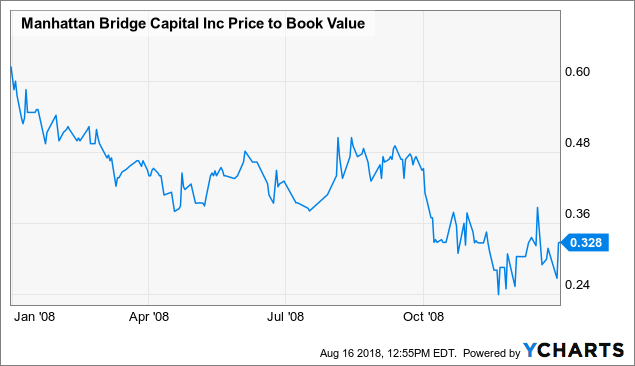 LOAN Price to Book Value data by
SACH’s most recent book value, as of 6/30/2018, stood at $3.60 per share (55.51M/15.41M). If we apply our disaster year earnings to this, BVPS is further reduced by -.20 to $3.40 per share. Applying the .328 multiple that LOAN experienced during the crisis yields a price of $1.11, implying a downside of just over 70% from a $4.15 current price. Note that this is very similar to the upside potential, which I also calculated to be about 70%.
However, I believe this crisis-like scenario is highly unlikely, especially due to measures put in place to decrease systemic risk (Basel III). With that said, investors should not ignore the potential for a black swan event.
Conclusion
Using their closest peer as a valuation benchmark, SACH trades at a substantial discount. Some of the discount may be justified based on SACH’s lack of operating history; however, my analysis suggests this discount is offset by SACH’s rapid growth and potential for stronger returns. With zero analysts covering the stock and with an early mishap in their reporting, the company has either been overlooked or written-off by potential investors. Nevertheless, SACH is putting the structure in place to drive long-term value creation. Further, the macro environment is supportive of SACH’s continued growth. Due to banks’ unwillingness to lend to smaller developers, as well as an aging housing stock that requires capital improvements, SACH is positioned well to capture this growing market opportunity. Based on the company’s price today and their strong operating performance, it is my opinion Sachem Capital Corp. is undervalued by approximately 70%.
Disclosure: I am/we are long SACH.
I wrote this article myself, and it expresses my own opinions. I am not receiving compensation for it (other than from Seeking Alpha). I have no business relationship with any company whose stock is mentioned in this article.
Additional disclosure: Cox Capital Management, LLC (www.coxcapitalmanagement.com) is long SACH. We intend to be long-term shareholders and have a multiple year time horizon. Invest at your own risk. Investment decisions need to be made in the context of suitability. This includes time horizon, total levels of wealth, willingness to assume risk, current income sources, and with respect to other assets in a portfolio. It is your responsibility to assess these factors. We do not guarantee the performance of any investment.
Editor’s Note: This article covers one or more stocks trading at less than $1 per share and/or with less than a $100 million market cap. Please be aware of the risks associated with these stocks.
Be the first to comment