
There seems to be a never-ending debate on the use of stops a part of a strategy, and my opinion is a resounding yes. Traders often get complacent and doubt the validity of stops during calm and rising market environments, only to abandon the strategy when it’s the most important. The truth is that most traders don’t use them simply because they don’t have a plan to begin with. As famous trader Marty Schwartz said, “that’s the problem with amateurs, they only have half a plan, the easy half”. What Schwartz means by this is that they know at what price they’re willing to sell for a profit, but they have not thought about what they will do if the position drops.
Even the best climbers who rarely slip or fall use a belay or rappel in case things don’t go as planned. Their logic is that they want to live to climb another mountain and they plan for the worst ahead of time, even if the worst scenario is a low probability. Based on this thinking, it would only make sense in trading where we have a 50% chance of failure on every trade that we would also use a support system of some sort. This is where stops come in. Whether mental or hard stops that is in the market, both provide a way to protect your account and significantly lower your risk of ruin.

One of the best discussions about stops I’ve come across is by Marty Schwartz in his book “Pit Bull”, and I’ve quoted an excerpt below:
One of the great tools of trading is the stop. The point at which you divorce yourself from your emotions and ego, and admit that you’re wrong. Most people have a tough time doing this, and instead of selling out a losing position, they’ll hang on, hoping the market will realize the error of its ways and behave as they believe it should. This attitude is usually self-destructive. They know how much of a profit they’re willing to take, but they don’t have the foggiest idea how much they’re willing to lose. They’re like deer in the headlights; they just freeze and wait to get run over. Their plan for a position that goes south is ‘Please God, let me out of this and I’ll never do it again.’ But that’s a lie, because if the position turns around, they’ll soon forget about God. They’ll go back to thinking that they’re geniuses and they’ll do it again which means they’re sure to get caught, and get caught bad. What most people fail to understand is that while you’re losing your money, you’re also losing your objectivity.”
One company that’s been a disaster for value investors the past year has been Newell Brands (NWL), and the value investors keep lining up to take a stab at this apparent “strong buy”. I initially wrote on the stock in my article “Stop Looking For Low P/E Ratio Stocks” and suggested the stock was a clear avoid even after it was already down 50% from its highs. The consensus was that the stock was too cheap to ignore especially given its dividend, but a 5% dividend is not going to do much to offset a negative return of 43% for the year.
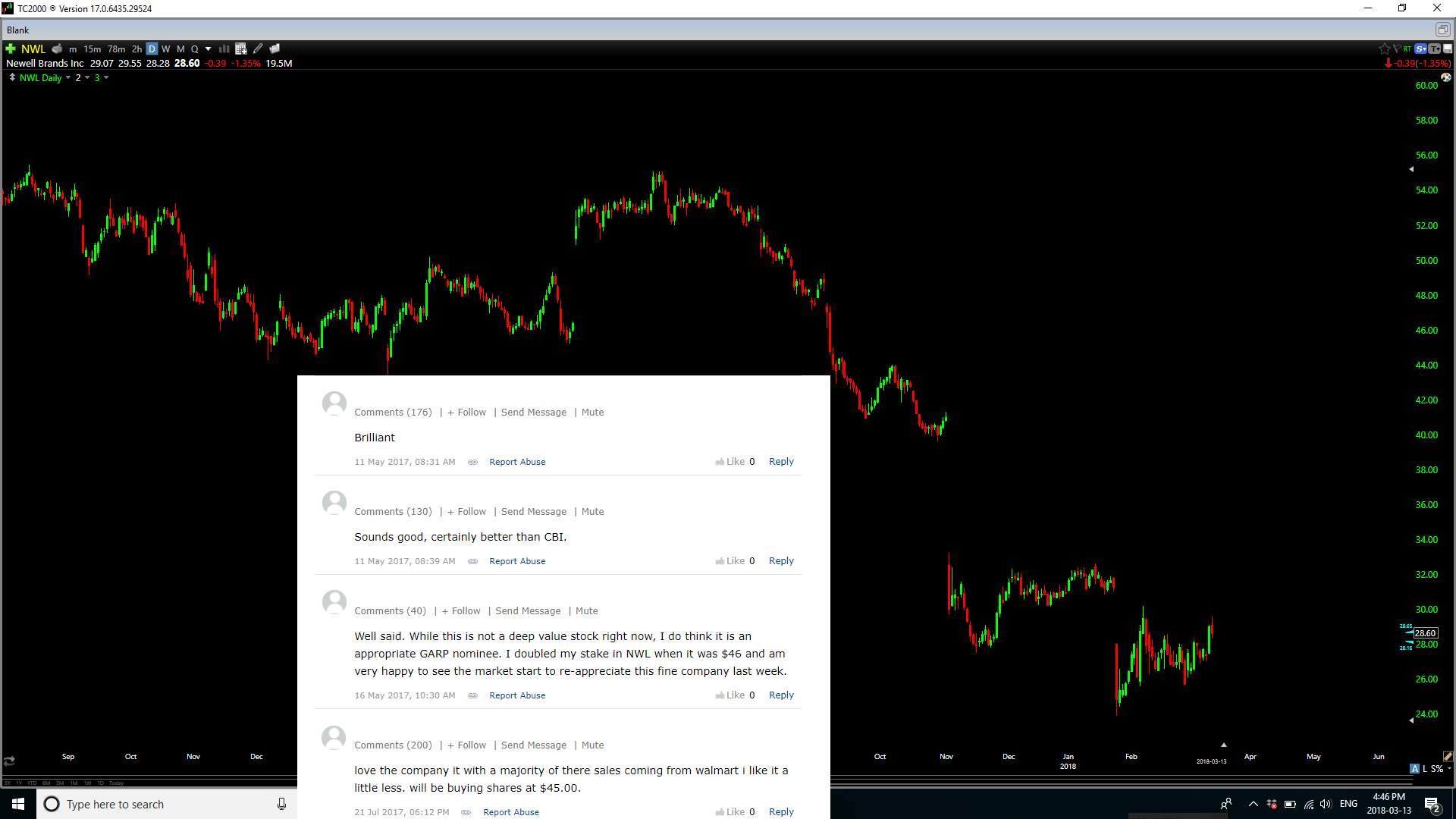
(Source: TC2000.com)
Despite Newell Brands already being down 50% from its highs at the time of my last article, the stock has taken another significant dive since. The before and after charts below show this, and we can see that the stock is now down an additional 40% from the $28.60 level earlier this year. So, how do you avoid being stuck in a money-pit like this? Stops, plain and simple. A rule of a mental stop or hard stop at a 10% level below one’s entry point would have averted a 70% drop for someone who bought at the highs or a 27% drop even if one bought the exact low in Q2.
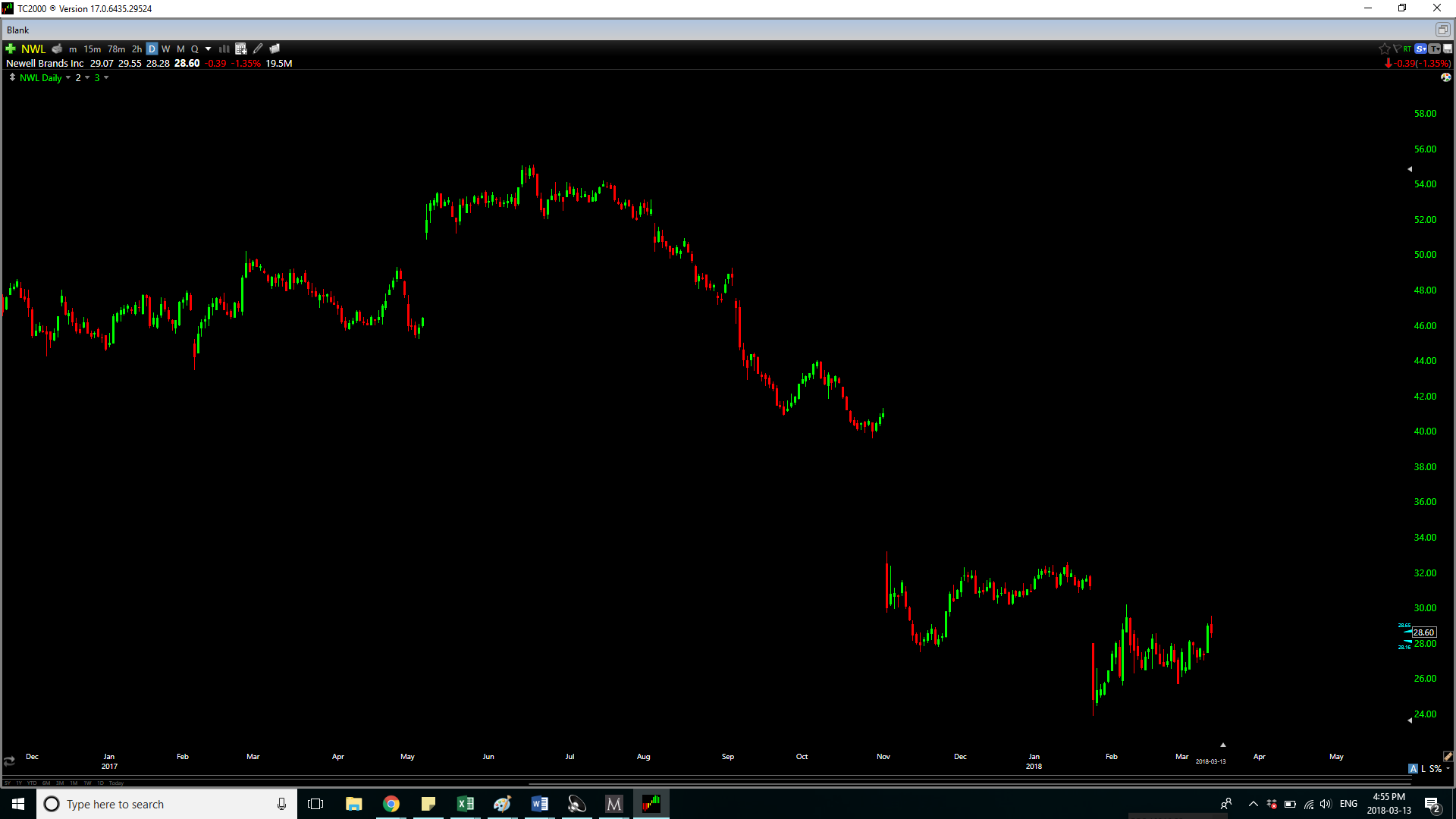
(Source: TC2000.com)
Of course, it’s not only with weak earnings that have been a disaster for investors this year. Facebook (FB) is another company that’s been a tough one for both investors and traders after underperforming the market by more than 15% this year. Even those who bought on the open after a 17% decline on their last earnings report (July 26th) have seen their position drop by more than 15%. A stop loss of 10% would have got investors out at the $162.00 level and also allowed them to take on a more objective view by being on the sidelines. While it’s entirely possible the stock rallies back to $180.00, there are no guarantees that the stock doesn’t head to $140.00 or lower first.
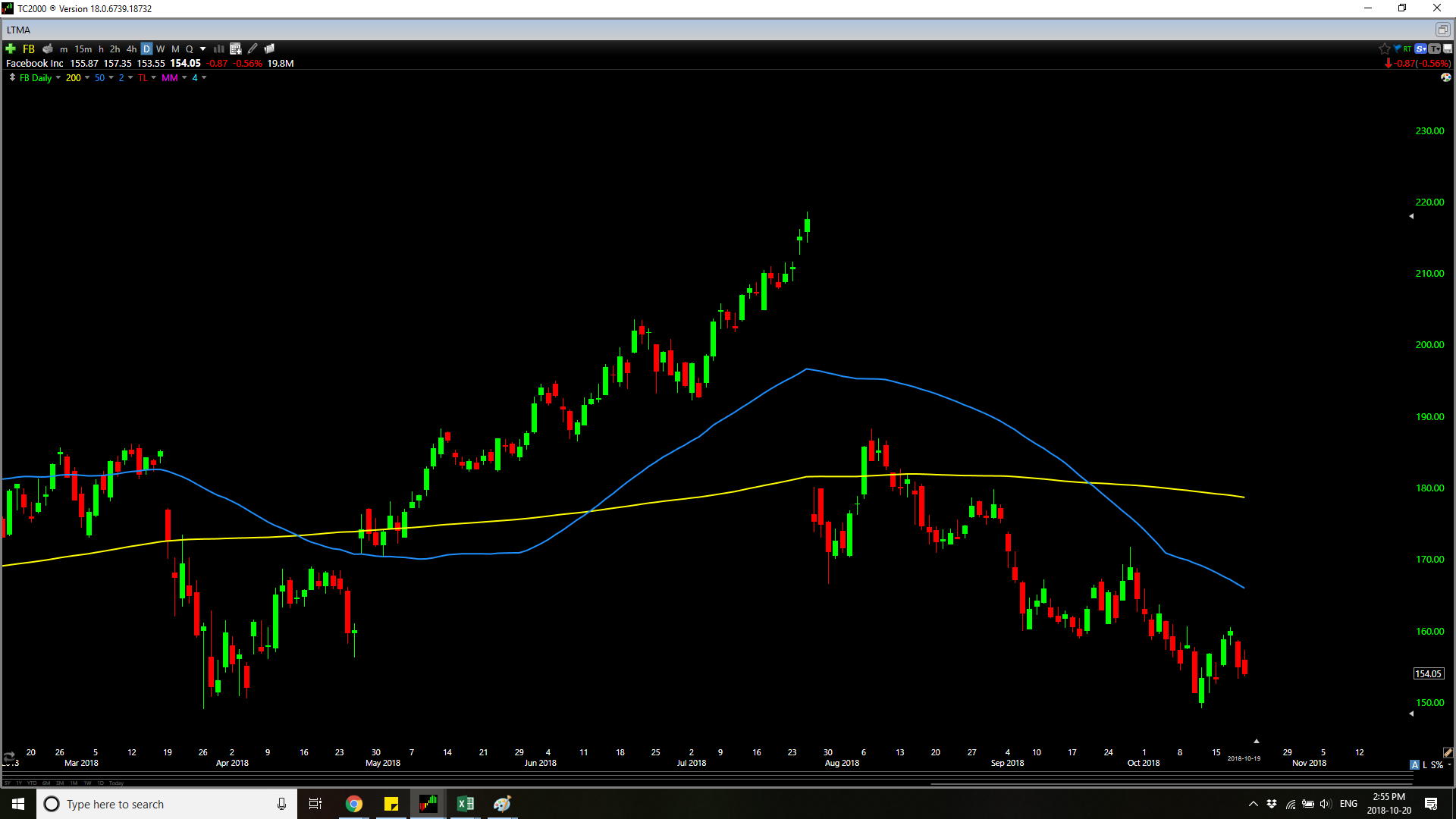
(Source: TC2000.com)
So, if we’ve determined that stops are a benefit to one’s trading or investing strategy to avoid disastrous investments when the market doesn’t agree with us, how do we apply them?
Hard Stops vs. Mental Stops
The two most common arguments against the use of stops I hear are that one should never sell at a loss and that stops can be manipulated only to see a stock reverse higher. While it’s true that our orders are visible when we put stops in the market, it’s unlikely unless we’re trading in very illiquid stocks or managing multi-million dollar portfolios that anyone is going to go after them (even if they can see them). No one cares about taking our 100 shares of Apple (AAPL) and it would take much more work to bring it down to a certain price that it wouldn’t be worth scooping up 100 shares.
However, if one is still skeptical and unwilling to place resting stop orders (hard stops), one has the option of using a mental stop and deciding on a price beforehand to exit the stock if it is violated. While this method has the benefit of not having to input orders, it also has three major drawbacks:
- You must have reliable alerts or be watching the market at all times so that you’re able to manually sell the stock in a timely fashion.
- You must have the discipline to sell if the stock does hit your uncle point.
- If the market opens strongly against you, you will not be filled on a first come/first serve basis. This could lead to you selling 3-5% lower or worse if the stocks hit the mental stop and begin to accelerate to the downside.
For the above reasons, but mainly for peace of mind, I have not found mental stops to be worth it for the majority of my strategies. While mental stops benefit from you not being shaken out in some cases near the lows, it’s rare you get shaken out in the first place unless your stops are placed poorly.
Using Stops:
When using stops and sizing positions, I am aiming to risk between 0.50% to 0.60% of my account on the majority of my trades. In some market environments though, I may go as low as 0.30% ($300 per $100,000). The idea behind risking only 0.5% of my portfolio on average is that my risk of ruin is so low. Given that we cannot control the distribution of winners to losers in trading, position sizing is extremely important. Even a system that is right 60% of the time (6 out of 10 trades), could see 10 losing trades in a row in a bad market environment. If one was risking 3% of their portfolio on each trade ($3,000 per $100,000), the portfolio would quickly find itself down 30%. By using a risk of 0.50% per trade, I can afford to see 10 losing trades in a row which is very rare but still only be down 5% in my total portfolio. The idea behind this is that I’m building failure into the system and planning for the worst.
So how does this work?
Below is a recent trade which did not work out:
I bought a 4.25% portfolio size in Royal Bank of Canada (RY) and knew that my stop would be roughly 6% from my entry price. This means that if I was entering at $81.13, I would be exiting at $76.25 worst case. Based on the fact that my stop was 6% away, and the most I was interested in risking in a tricky market environment was 0.30% of my portfolio, I sized the position for 4.25%. A 4.25% portfolio size multiplied by a risk on the position of 6% equals out to just below a 0.30% loss to the portfolio assuming the trade did not work (0.0425 x 6.00 = 0.26%~).
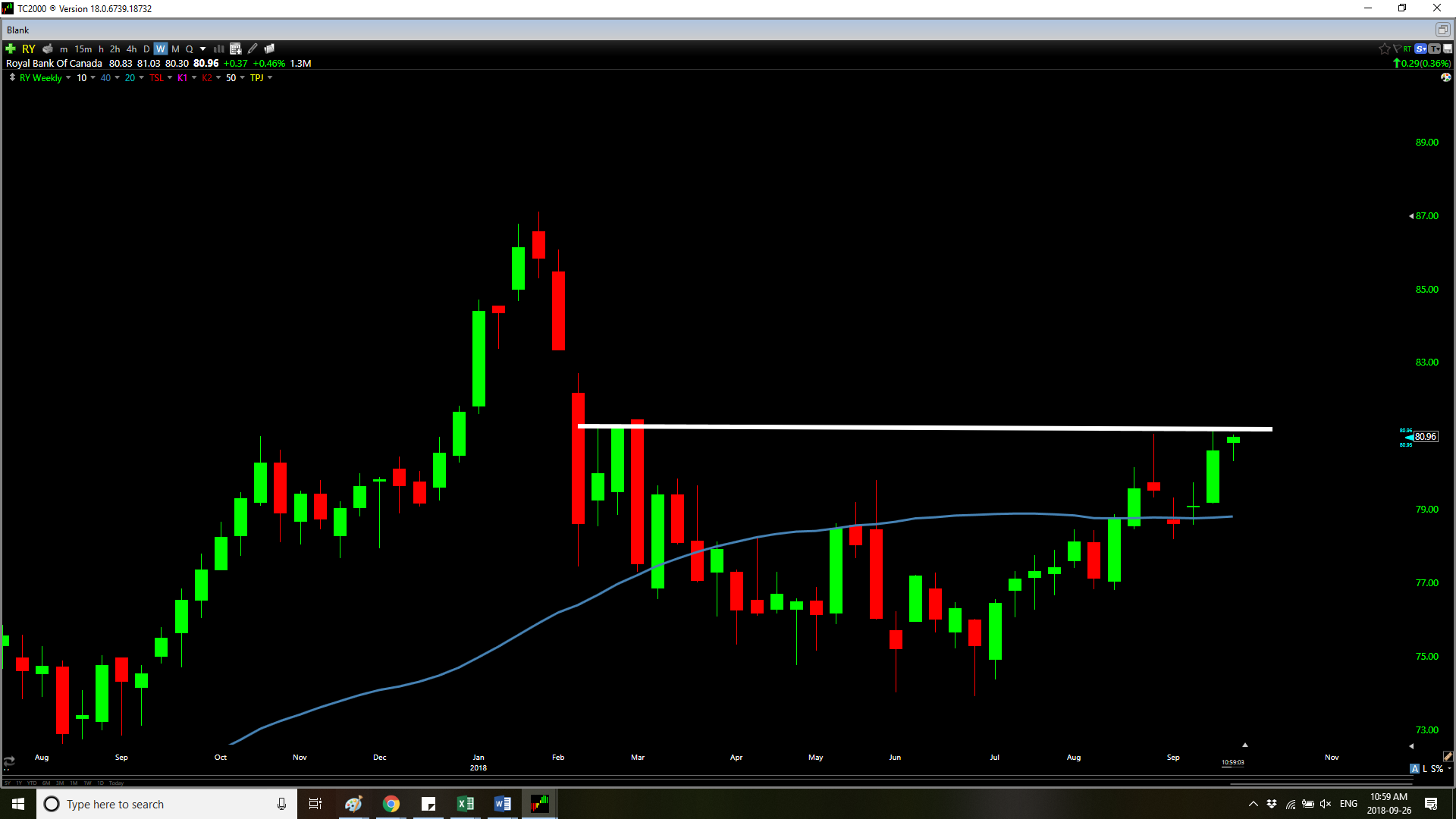
(Source: TC2000.com)
The stock is now trading another 1% below where I was stopped out of the trade, and while it may end up working, I like to keep my losses small. My average winning trade in my portfolio for the past 20 closed positions is over 30%, and my average losing trade is 5.50%. This means that I can be right on only 2 out of every 10 trades and still manage to be profitable. If I did not use stops, my average loser could easily be in the 15-20% range especially with a stock like Newell Brands thrown into the mix.
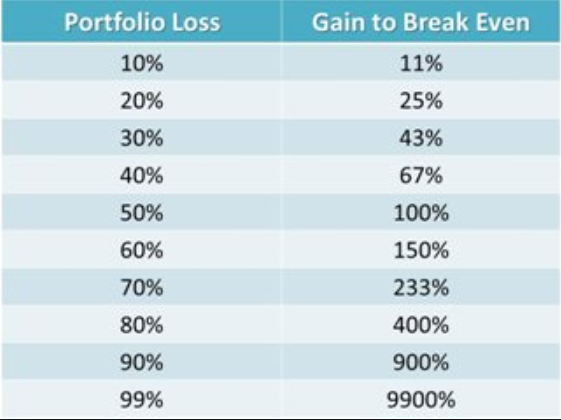
For those aware of the math of trading, we know that winners and losers are not equal. A 10% loss requires an 11% gain to break-even, a 20% loss requires a 25% gain to break-even, and a 50% loss requires a 100% gain to break-even. This is why defense is so important in trading and the focus in one’s mind should always be “small losses, small losses”.
As we enter into what looks to be a more volatile market period; hopefully, this article can help some traders to understand the importance of having an uncle point (stop), so that they don’t get stuck with duds like Newell Brands in the future. There is nothing wrong with being wrong in trading, the mistake lies in staying wrong. A stop lets you become objective and see clearly after exiting a loser as you can take a second look at the situation and determine if you really wanted to be in there based on the new developments. In most cases, a trader after being out of the position will realize the flaws with the trade, but this could only be done once they were no longer emotionally attached to the stock. The goal in trading for position traders and swing traders should be to limit all losses to 12% or loss. The further below this level one gets, the worst off the math gets in terms of gain required to break-even.
Author’s Note:
I would love to know what companies you believe are superior long ideas that are underrated. While I do track 3000+ stocks on a daily basis, there are always a few that fly under my radar. My articles get plenty of comments, and I’m always open to new ideas and food for thought. If you like this article and hope to see more like it in the future, check the little thumbs up at the end of the article. In addition, please feel free to follow me by clicking on my name next to my avatar at the top of this article.
Disclosure: I/we have no positions in any stocks mentioned, and no plans to initiate any positions within the next 72 hours.
I wrote this article myself, and it expresses my own opinions. I am not receiving compensation for it (other than from Seeking Alpha). I have no business relationship with any company whose stock is mentioned in this article.
Be the first to comment