Investing in stocks is an art, not a science, and people who’ve been trained to rigidly quantify everything have a big disadvantage. – Peter Lynch
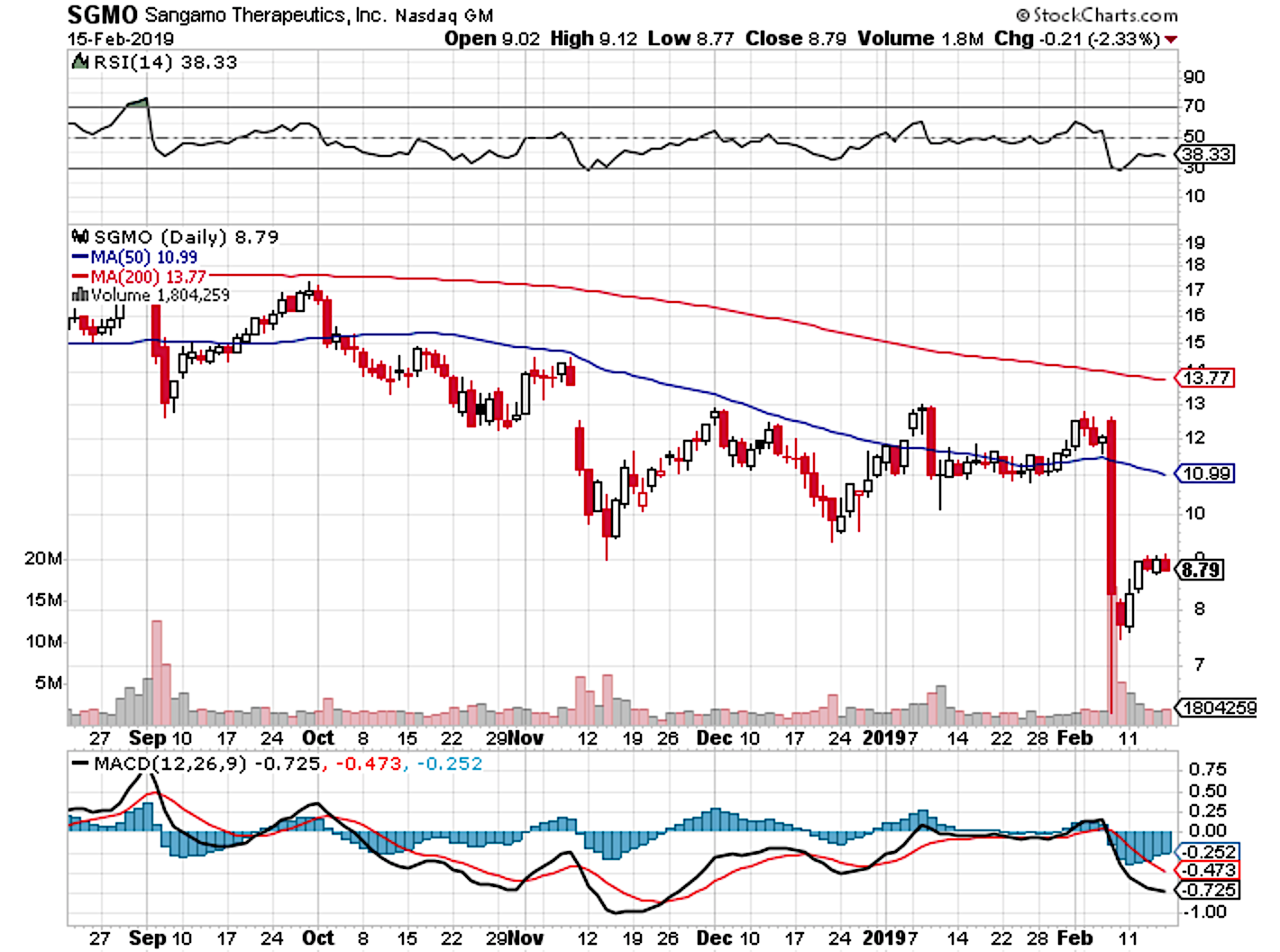
On Feb. 07, 2019, Sangamo (SGMO) published the results of the Phase 1/2 (Empowers and Champions) studies for its orphan disease franchise. As follow, Empowers and Champions are investigating the efficacy and safety of the lead gene-editing molecule (SB-318 and SB-913) in patients afflicted by the lysosomal diseases coined Mucopolysaccharidosis (“MPS”) Type I and II, respectively. Interestingly, the market was unimpressed with the clinical outcomes because there was a 30% sell-off in one trading session. In this Competitive Intelligence Report (“CIR”), we’ll provide readers with an in-depth analysis of the latest data release.
Figure 1: Sangamo chart (Source: StockCharts)
Disease Background
As lysosomal storage disorders, MPS Type I and II are caused by a deficiency in the lysosomal enzymes required for the breakdown of a mucopolysaccharide known as glycosaminoglycan (“GAG”) and heparan as well as dermatan sulfate. As these sugars build up, they compromise the function of lysosome (i.e. the storage organ of the cell) and thereby leads to a plethora of symptoms that include the following: abnormal facial appearance, enlarged liver and spleen (hepatosplenomegaly), heart disorders, dwarfism, neurocognitive decline, and deafness. While both types exhibit similar symptoms, MPS II (Hunter syndrome) tend to manifest later in the disease course. Additionally, patients with Hunter have distinctive papular skin lesion.
| Disease | Enzyme deficiency | Drug | Product buildup | Clinical trial |
| MPS I (Hurler, Scheie) | alpha-L-iduronidase (“IDUA”) | SB-318 | glycosaminoglycans (“GAGs”), heparan sulfate, and dermatan sulfate | Empowers (Phase 1/2) |
| MPS II (Hunter) | iduronate 2-sulfatase (“IDS”) | SB-913 | glycosaminoglycans (“GAGs”), heparan sulfate, and dermatan sulfate | Champions (Phase 1/2) |
Table 1: Lysosomal storage disease (Source: Integrated BioSci Investing)
Gene-Editing Therapy
Accordingly, the gene-editing therapies (SB-318 and SB-913) are packaged inside the adeno-associated virus (“AAV”) 2 and 6. Inside the viral vector are the correct genes encoding the enzymes (IDUA and IDS) plus a zinc finger nuclease (“ZFN”). As a molecular scissor, ZFN cuts the genetic blueprint (“DNA”) for the correct genes to be inserted.
We believe it is quite strategic that SB-318 and SB-913 transferred the correct genes next to a “promoter” of the albumin protein: this enables the ramping of gene expression inside the liver. In our view, this approach is more competitive than conventional enzyme replacement therapy (“ERT”) due to the less frequent need for treatment that, in and of itself, leads to better compliance and improve disease outcome. Furthermore, it replaces the need for a bone marrow transplant which has a long waiting time and other associated complications.
Champions’ Interim Results
For Empowers and Champions, the investigators initially measured the patients’ baseline level of urinary GAG and IDUA or IDS enzymatic activity. These patients were then given an injection of either SB-318 or SB-913 in different dosages, ranging from low, mid to high. Their enzyme activity and urinary GAG were subsequently assessed every two to four weeks. Back in Sep. 05, 2018, Sangamo reported what seemed to be excellent week-16 data for Champions. We noted in our prior research:
The corresponding mean reduction of GAG, dermatan sulfate, and heparan sulfate of Group (Cohort) 2 at week-16 were 51%, 32%, and 61%. The low-dose group (Cohort 1) showed mixed results for all three metrics. The fact that the medium dose Cohort 2 exhibited the positive outcomes (for GAG, dermatan sulfate, and heparan sulfate) proves that the SB-913 works by a dose-response relationship. In other words, the higher dose works better than the low dose and thus indicates good therapeutic efficacy.

Table 2: Champions week-16 results (Source: Sangamo)
Latest Empowers And Champions Data
Despite the highly favorable interim results at week-16, the latest outcomes at week-24 for Empowers and Champions were disappointing to investors. Be that as it may, there are more to this story than what is apparent in the press release.
In Champions, the primary objective was met because the drug was well-tolerated. For instance, most side effects were mild (i.e. Grade 1). Re the secondary outcome that is efficacy, there were small increases in IDS enzymatic activity from baseline for two patients (on the mid-dose) and one patient (on the high-dose). Unfortunately, the increased level still remained within the baseline range at week-24. Specifically, the activity level persisted at less than 10 nmol/hour/mL versus the normal range of 82 nmol/hour/mL. Additionally, the urinary GAG did not demonstrate a meaningful improvement from baseline.
Pertaining to Empowers, the safety profile was similar to Champions. In terms of efficacy, there was a “dose-dependent increase in leukocyte IDUA activity, with activity levels rising above baseline and in the normal range (normal range is 6.0-71.4 nmol/hr/mg).” Nevertheless, the plasma IDUA activity was similar to baseline for all three patients. Furthermore, the urinary GAG did not indicate a meaningful improvement from baseline.
CIR Take Home
Viewing the totality of the results, we strongly believe that the efficacy was there: the reverse transcription polymerase chain reaction (RT-qPCR) confirmed the expression of the IDS mRNA transcript in two patients who got the mid-dose SB-913.
The fact that there was low enzyme activity indicates that an immune reaction most probably occurred against SB-318. After all, SB-913 demonstrated very high activity at week-16 in the prior interim results reported last year. Something must have developed in the intervening period to lower the enzymatic activity level at week-24. Our belief that an immune response is the culprit coincides with the statement made by Sangamo:
A more substantial increase in plasma IDS activity was measured in the second patient in the high dose cohort, with levels rising to approximately 50 nmol/hour/mL by week-6 following SB-913 administration. The plasma IDS activity levels subsequently decreased in the context of development of a mild transaminitis – a known risk of AAV-based therapies – due to a suspected immune response.
In our view, the human body has a way of defending against injected “foreign” materials. And, gene-editing therapy is considered foreign to the immune system. Hence, it’s quite likely that the trial investigators either did not pretreat patients with a steroid or the steroid was delivered at a sub-therapeutic dose. Notwithstanding, we believe that this can be easily ameliorated by pretreatment with the proper steroid dosage (i.e. prednisone).
Another plausible explanation is that these patients are concurrently being treated with an ERT. Despite some setbacks like antibody formation, ERT is an efficacious and safe management approach that has been utilized for decades. Consequently, we believe that the effects of ERT might have masked the therapeutic efficacy of SB-318 and SB-913. To tease out this potential confounder, Sangamo initiated the ERT-withdrawal protocol. Per the company:
One mid-dose patient was recommended to resume ERT approximately 3 months after initiation of ERT withdrawal due to fatigue and increasing GAGs. Analyses from these withdrawals will be available later in 2019.
That aside, it’s quite likely that the low efficacy was due to the use of AAV2 and AAV6. They are early-generation delivery vectors which can have significant issues, especially immunogenicity. Of note, companies like Regenxbio (RGNX) and Solid Biosciences (SLDB) are employing the next-generation AAVs (7-9) which have better delivery success. Fortunately, for shareholders, Sangamo is also tinkering with the second-generation ZFN. According to the press release:
Sangamo has developed second-generation, potentially more potent ZFN constructs designed to increase editing efficiency. Preclinical data of these second-generation ZFNs were reviewed by U.S. regulators. The preclinical data showed three potential advantages for use in the clinic: (1) a 5- to 30-fold improvement in efficiency and potency due to structural changes; (2) the ability to function equally well in the patients who have a single nucleotide polymorphism (“SNP”) in the target locus in the albumin gene (approximately 20% of the population); (3) improved specificity. The second-generation ZFNs are already being manufactured and are expected to be ready for evaluation in the clinic later this year. Additional data from Sangamo’s in vivo genome editing programs will be assessed before potential integration plans for the second-generation ZFNs are finalized.
Final Remarks
In all, Sangamo is brewing a highly diverse therapeutic pipeline to have more “shots on goal” of finding a blockbuster. Despite what is seemingly subpar clinical outcomes for SB-319 and SB-913, the situation can be ameliorated with trial protocol adjustment. As the company is targeting the orphan disease market, if the investigational drugs pass their clinical studies and ultimately gain approval, they can procure substantial revenues. The average reimbursement for an orphan drug is $140K annually. Therefore, this can generate significant cash flow to fund more lifesaving innovation. While Sangamo is a highly promising company, we’ll wait for the firm to adjust the clinical protocol and provide more data prior to making our next long-term recommendation. Last but not least, you can learn more about specific investment strategy and recommendation on Sangamo by visiting our marketplace service.
Housekeeping
Thanks for reading! To get the latest articles, please hit the orange “Follow” button on top.
Be sure to check out our private investment research community, Integrated BioSci Investing.
Dr. Tran’s analyses are the best in the biotech sphere, well worth the price of the subscription.
Very professional, extremely knowledgeable and very honest … I would highly recommend this service and his stock picks have been very profitable.
Simply put, this is worth every penny. Just earlier today, one of the companies recommended by Dr. Tran got acquired for a nice 50% premium.
Click here for a FREE TRIAL.
Disclosure: I/we have no positions in any stocks mentioned, and no plans to initiate any positions within the next 72 hours. I wrote this article myself, and it expresses my own opinions. I am not receiving compensation for it (other than from Seeking Alpha). I have no business relationship with any company whose stock is mentioned in this article.
Additional disclosure: As a medical doctor/market expert, Dr. Tran is not a registered investment advisor. Despite that we strive to provide the most accurate information, we neither guarantee the accuracy nor timeliness. Past performance does NOT guarantee future results. We reserve the right to make any investment decision for ourselves and our affiliates pertaining to any security without notification except where it is required by law. We are also NOT responsible for the action of our affiliates. The thesis that we presented may change anytime due to the changing nature of information itself. Investing in stocks and options can result in a loss of capital. The information presented should NOT be construed as recommendations to buy or sell any form of security. Our articles are best utilized as educational and informational materials to assist investors in your own due diligence process. That said, you are expected to perform your own due diligence and take responsibility for your action. You should also consult with your own financial advisor for specific guidance, as financial circumstance are individualized.
Be the first to comment