
For those watching Legacy Reserves (LGCY) lately, there has been a lot of downward pressure on the stock on essentially no material news. Not anymore though. Two sets of updates offered through the SEC’s EDGAR Database show not only fresh momentum from the company’s largest shareholder, but also an innovative move by management that, if applied on a broader scale to the business, could solve many of its troubles, but that would come at a cost to shareholders.
Baines is moving again
For the past couple of months now, investors were likely thinking that Baines Creek Capital was all tapped out. After having deployed around $50 million or so to snatch up 24.1 million units, or 18.8% of the business after adjusting for some convertible notes outstanding as of the most recent quarter, that would be an understandable assumption given that the company stopped buying units for an extended period of time. Now, though, the company appears to be back in action. Between Dec. 6 and Dec. 10, the business purchased nearly 0.384 million units at an weighted-average purchase price of $1.94 apiece.
This aggregate investment of $0.745 million has brought Baines’ total holdings in the business up to 24.48 million units, or about 19.1% of the entity. Adjusted for the notes swap I will discuss shortly, and assuming that Baines was not the beneficiary there, the ownership today stands at 18.8%. There’s no telling how much capital, if any, that Baines may still have on hand to deploy, but the fact that they were able to allocate more after seeing shares fall as hard as they have in recent months (from a multi-year high above $10 to south of $2 as of the time of this writing) is a testament to their continued commitment toward their position.
Management engaged in an innovative swap
Also, in just the past day or so, the management team at Legacy announced a new stock-for-notes swap that it engaged in, split between one transaction agreed upon on Nov. 21 and another agreed upon on Dec. 5. In the November swap, the company issued to the holders 1 million units of Legacy’s stock in exchange for $3.1 million worth of principal of 8% 2020 Senior Notes. In the December transaction, they issued another 1 million units in exchange for $2.7 million worth of principal of 6.625% 2021 Senior Notes.
By themselves, these transactions are small and total savings for the business will be minimal. According to my math, by diluting shareholders 1.5%, the firm will not just save the $5.8 million in principal, but will save $0.427 million worth of interest expense per annum. Perhaps more important than these dollar amounts, though, is what this strategy could mean for Legacy in the long run. You see, net of these swaps and net of $130 million worth of convertible notes, Legacy has a significant amount of debt right now. By my calculations, it stands at $1.21 billion and, with the exception of a revolving credit facility that’s likely to be renewed early next year, the next chunk of debt that will come due will be set for 2020.
Based on the closing share price for Legacy on each of the days the transactions took place, the effective price paid on the 2020 bonds was about $0.803 on the dollar compared to the $0.7706 on the dollar that they traded for that day. The 2021 bonds were done at an effective price of $0.744 on the dollar, up from the $0.7017 on the dollar that they were trading at the time. This means that some premium was paid over the market value of the Senior Notes, but given that consideration was in shares as opposed to cash, that makes sense.
If management were to take this set of transactions as a test, they could apply the same methodology to other bondholders. It’s highly improbable that all of the note holders of a given class would opt to swap, but if you were to apply the current methodology, with the same premium paid but adjusted for the current bond price of $0.609 on the dollar for the 8% 2020 Senior Notes, then the remaining $208.885 million worth of notes could be paid off in exchange for 70.698 million shares (at $1.875 per share).
*Created by Author
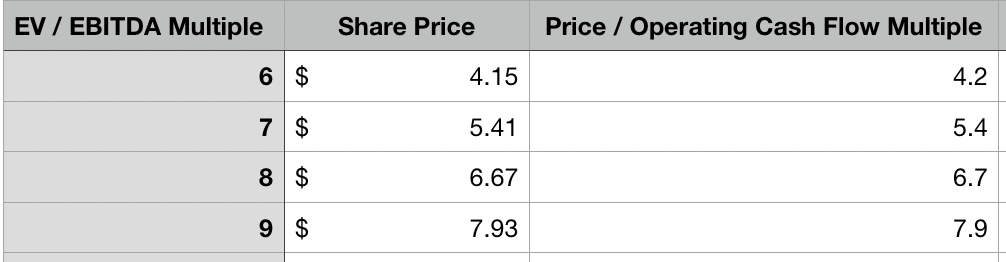
In the table above, you can see, based on the EV / EBITDA multiple of a range of 6 to 9, where shares would be priced following said transaction. Despite tremendous dilution to common investors, the move would still leave upside to shareholders, and even if it were, on an EV basis, to be priced at 9 times EBITDA, shares would be trading for 7.7 times operating cash flow. Assuming a scenario where convertible notes end up converting, this would leave Legacy with a debt / EBITDA ratio of 3.13 in a world where oil averages $50 per barrel into perpetuity and where natural gas averages $3.25 per Mcf. With convertible notes classed as debt still, the leverage ratio would be 3.54.
*Created by Author
In the next table, shown above, you can see what would happen if both sets of Senior Notes could be exchanged in their entirety based on this methodology. The low end upside doesn’t change much, but in a world where production grows at only 10% per annum and where the value range I provided is accurate, the upside potential is limited. Still, all of these prices are several hundreds of percents above where shares are trading for today. It should be mentioned here that the leverage ratio under this scenario, excluding convertible notes, would be just 2.71, while with the convertible notes it would climb to 3.12.
The other day, I published an article illustrating just how much wiggle room Legacy has compared to what its covenants define to be acceptable. My conclusion was that there appears to be little chance of bankruptcy and I believe that to still be the case. That said, if management can strike a deal with its 8% Senior Notes holders, and even if energy prices remain depressed like they are today, the firm would go from having little risk of bankruptcy to nearly zero risk. At a leverage ratio of around 3, Legacy could comfortably refinance its debt by issuing Senior Notes in exchange for the Second Lien debt and I couldn’t see any scenario (other than one where energy prices plunge and stay depressed for years) where extending the credit facility and refinancing its remaining 6.625% Senior Notes doesn’t happen without too much of a problem.
Takeaway
I understand why some investors in Legacy might feel bearish, but when you consider the different options at the firm’s disposal, and when you consider its robust cash flow position even with current energy prices, I find it hard to be bearish on the business at this time. In all, Legacy makes for an attractive long-term prospect in the energy space, and especially when oil prices move higher than what we are seeing today, investors are likely to enjoy a nice ride higher.
A community of oil and natural gas investors with a hankering for the E&P space: Crude Value Insights is an exclusive community of investors who have a taste for oil and natural gas firms. Our main interest is on cash flow and the value and growth prospects that generate the strongest potential for investors. You get access to a 50+ stock model account, in-depth cash flow analyses of E&P firms, and a Live Chat where members can share their knowledge and experiences with one another. Sign up now and your first two weeks are free!
Disclosure: I am/we are long LGCY. I wrote this article myself, and it expresses my own opinions. I am not receiving compensation for it (other than from Seeking Alpha). I have no business relationship with any company whose stock is mentioned in this article.
Be the first to comment