
I have been talking quite a bit about the U.S. airline sector lately, following a broad study that I have recently concluded on the industry. Although I have already picked my potential winners, namely Delta (DAL) and Southwest (LUV), I recognize that investing in the space is a fairly risky proposition due to the sector’s high sensitivity to fuel price swings and the health of the macro-economic landscape.
Credit: IB Times
One common strategy to manage company-specific risk is diversification. For this purpose, a low-cost ETF tends to be a good approach. Therefore, investors looking to dip their toes into the volatile airline space but not confident enough to make timely bets on one or two specific stocks might be interested in the U.S. Global Jets ETF (JETS).
JETS is an air travel sector fund (the only of its kind, to the best of my knowledge) that allows money to be invested into a number of companies across the entire industry. The fund also can be a good option for high-conviction investors looking to make sector-wide bets, as opposed to company-specific ones.
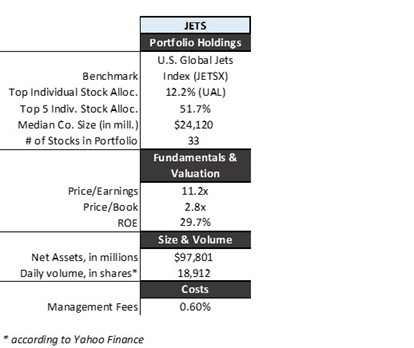
The table below summarizes some of the key characteristics of this ETF.
Source: DM Martins Research, using data from U.S. Global ETFs
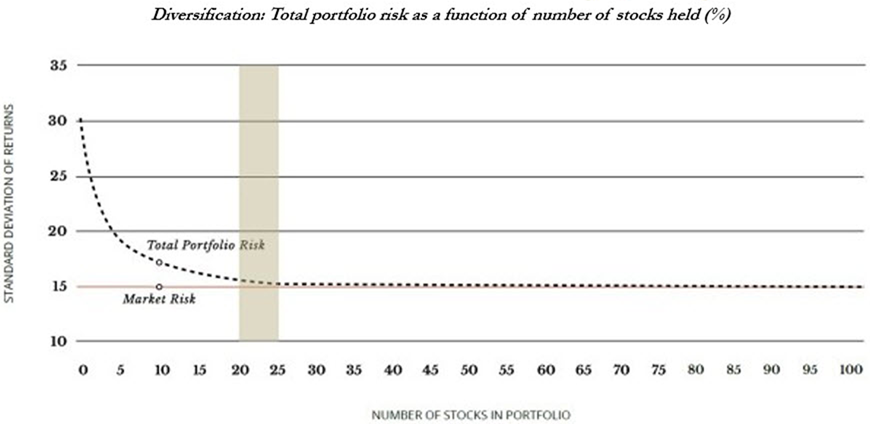
One of the fund’s main features stand out to me at first glance. Although minimally diversified (the ETF holds only 33 names, barely enough to eliminate non-systematic risk, per the chart below), the number of different stocks in the portfolio surpasses my expectations for a U.S. market that’s largely dominated by seven legacy and low-cost airlines. The explanation: JETS invests nearly 10% of its AUM in U.S.-based, non-carrier stocks, including aircraft makers Boeing (BA) and Textron (TXT). It also allocates about 18% of the total assets to non-U.S. names in the air travel and aviation business.
Source: Intrinsic Investing
On the other hand, the benchmark that JETS tracks (the U.S. Global Jets Index) has been designed to allocate 12% of the total assets to “each of the four largest U.S. passenger airline companies, as measured primarily by their market capitalization and, to a lesser extent, their passenger load factor.” The end result is a portfolio that is materially exposed (nearly 50% AUM allocation) to the four largest U.S. airlines: United Continental (UAL), LUV, DAL and American Airlines (AAL).
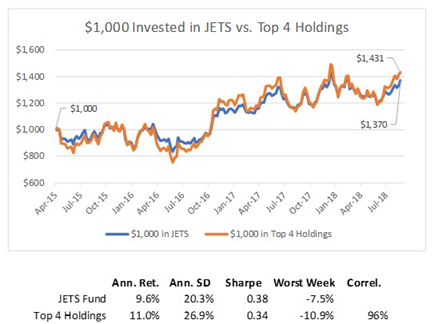
The chart below illustrates how $1,000 placed in JETS since its April 2015 inception through September 2018 would have returned less than a portfolio invested in the top four JETS holdings. The results, however, would have come with a more favorable level or risk/volatility that’s likely associated with the broader diversification feature of the ETF. Correlation between the two hypothetical portfolios would have been a very high 96%.
Source: DM Martins Research, using data from Yahoo Finance
Lastly but also very importantly, JETS charges a management fee of 0.6% that I find reasonable, even if not necessarily a bargain. Fund costs are a crucial factor in the investment decision, particularly for large sums of money invested over a multi-year or multi-decade period. For example, a $1 million portfolio invested for 40 years in an group of assets expected to return 9% per year will “bleed out” an estimated $1.1 million over the period for every 10 bps in management fee charged.
Key conclusion
In the end, I believe JETS is a good, diversified alternative for investors willing to gain exposure to the air travel sector without much non-systematic exposure. I think the ETF is particularly attractive for investors with smaller sums of money (trading costs incurred to build and rebalance the portfolio would likely exceed the ETF’s management expenses) who do not mind some exposure to international stocks.
Note from the author: I have recently concluded a study on the U.S. airline sector, and shared my findings first – along with my working Excel file containing all the details – with my Storm-Resistant Growth group. To access all the premium material and dig deeper into how I have built a risk-diversified portfolio designed and back-tested to generate market-like returns with lower risk, join the Storm-Resistant Growth community. Take advantage of the 14-day free trial, read all the content written to date and participate in the discussions.
Disclosure: I am/we are long LUV.
I wrote this article myself, and it expresses my own opinions. I am not receiving compensation for it (other than from Seeking Alpha). I have no business relationship with any company whose stock is mentioned in this article.
Be the first to comment